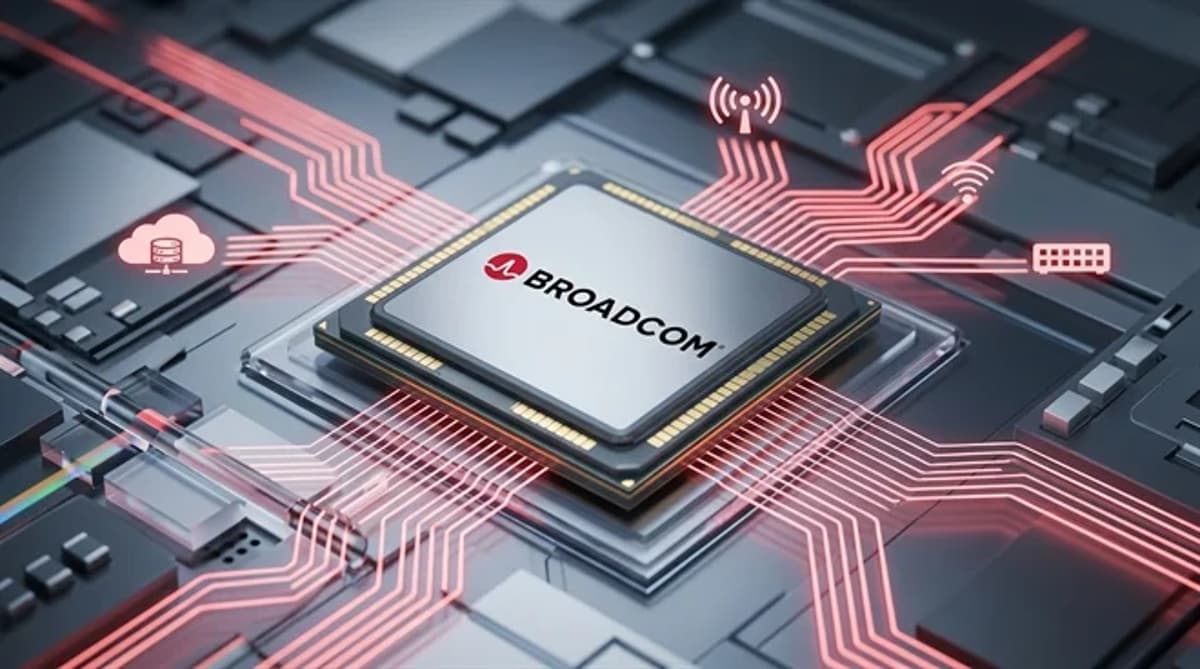
Broadcom Hits $2 Trillion Market Cap as Google Reveals New AI Chips
Companies Mentioned
Why It Matters
The split‑chip strategy deepens Broadcom’s role in the AI hardware stack, unlocking new revenue streams and reinforcing its position with hyperscale customers. As AI workloads expand, the partnership could accelerate Broadcom’s growth and justify its trillion‑dollar valuation.
Key Takeaways
- •Google's TPU 8t targets training; TPU 8i targets inference
- •Two‑chip TPU design doubles inference performance per dollar
- •Broadcom gains design revenue from separate training and inference chips
- •Five hyperscalers adopt two‑chip‑a‑year roadmaps, boosting demand
- •Broadcom’s $2 trillion market cap reflects AI partnership momentum
Pulse Analysis
Broadcom’s climb to a $2 trillion market capitalization underscores how critical AI‑focused silicon partnerships have become in today’s tech landscape. The company’s long‑standing collaboration with Alphabet’s Google has evolved from a single‑chip TPU roadmap to a dual‑chip architecture, positioning Broadcom as a pivotal supplier for the next wave of AI workloads. This milestone arrives as investors scramble to price in the long‑term earnings potential of AI infrastructure, a sector where hardware differentiation can translate directly into premium pricing and market share gains.
Google’s eighth‑generation TPUs introduce a clear division of labor: the TPU 8t is engineered for massive training models, while the TPU 8i serves latency‑sensitive inference tasks. By delivering roughly 80 % more performance per dollar on inference, the 8i enables enterprises to process nearly twice the queries without extra spend, a compelling value proposition for cost‑conscious hyperscalers. The two‑chip design also allows Google to fine‑tune silicon for each workload, extracting efficiency gains that generic GPUs cannot match, and reinforcing Broadcom’s expertise in custom ASIC development.
The two‑chip‑per‑year cadence is rapidly gaining traction beyond Google, with Meta and at least five other hyperscalers publicly committing to similar roadmaps. This broader adoption amplifies Broadcom’s design‑service revenue opportunities and creates a virtuous cycle of demand for specialized AI silicon. While the company’s forward P/E remains modest, the upside hinges on sustained hyperscaler spending; any slowdown could pressure valuations. Nonetheless, the partnership’s scalability and the industry’s shift toward hardware‑level specialization suggest Broadcom is well‑positioned to capture a growing slice of the AI spend pie.
Broadcom Hits $2 Trillion Market Cap as Google Reveals New AI Chips
Comments
Want to join the conversation?
Loading comments...