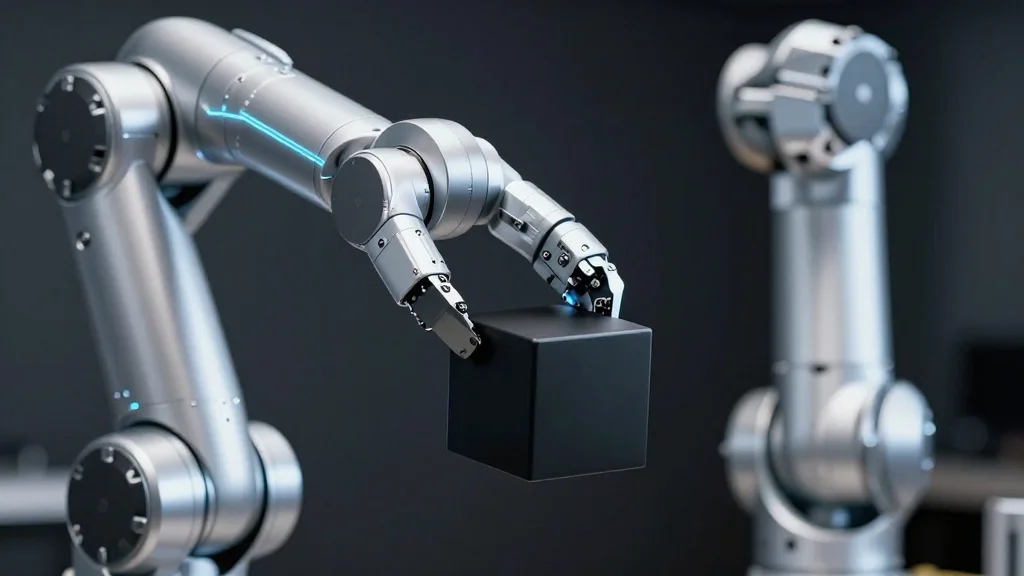
Cadence and Nvidia Are Bridging the Simulation Gap That’s Slowing Down Robotics
Companies Mentioned
Why It Matters
Accurate simulated training data accelerates robot readiness, reducing costly physical testing and speeding time‑to‑market. The partnership gives both firms a foothold in the rapidly growing demand for trustworthy robot AI pipelines.
Key Takeaways
- •Cadence’s physics engine now feeds Nvidia’s Isaac training pipelines.
- •High‑fidelity simulation reduces robot‑to‑real deployment time.
- •Partnership extends Cadence beyond chip design into AI infrastructure.
- •Nvidia integrates results on Jetson edge‑AI hardware for robotics.
- •Industry sees surge in demand for accurate robot training data.
Pulse Analysis
The disconnect between virtual training environments and physical robot performance has long hampered rapid deployment of autonomous systems. Cadence Design Systems, traditionally a leader in semiconductor design tools, brings its multiphysics engines—capable of modeling material deformation, fluid dynamics, and contact forces—to the robotics arena. Nvidia, with its Isaac simulation suite and Cosmos open‑world models, supplies the AI‑centric training infrastructure that powers deep‑learning policies. By marrying Cadence’s high‑fidelity physics with Nvidia’s scalable GPU pipelines, the partnership promises a more realistic data pipeline that narrows the simulation‑reality gap.
The combined stack operates as a closed‑loop workflow: world models generated in Nvidia’s Cosmos feed into Cadence’s physics solver, producing training datasets that capture nuanced interactions such as slip, compliance, and variable friction. These datasets are then consumed by Isaac’s reinforcement‑learning algorithms, which iterate on GPU clusters before deploying the resulting policies onto Nvidia’s Jetson edge‑AI modules. This end‑to‑end pipeline cuts the time‑to‑market for robot applications—from weeks of physical trial‑and‑error to days of simulated refinement—while slashing hardware wear and test‑lab costs.
Beyond the immediate technical gains, the alliance signals a strategic shift in how the robotics ecosystem sources its development tools. Competitors like Siemens and Dassault Systèmes are pursuing similar virtual‑twin collaborations, but Cadence’s chip‑design pedigree gives it a unique edge in modeling electronic‑mechanical interactions critical for next‑generation collaborative robots. As manufacturers accelerate adoption of AI‑driven automation, demand for trustworthy simulation data will become a decisive factor in supplier selection, positioning Cadence and Nvidia as pivotal enablers of the industry’s next productivity wave.
Cadence and Nvidia are bridging the simulation gap that’s slowing down robotics
Comments
Want to join the conversation?
Loading comments...