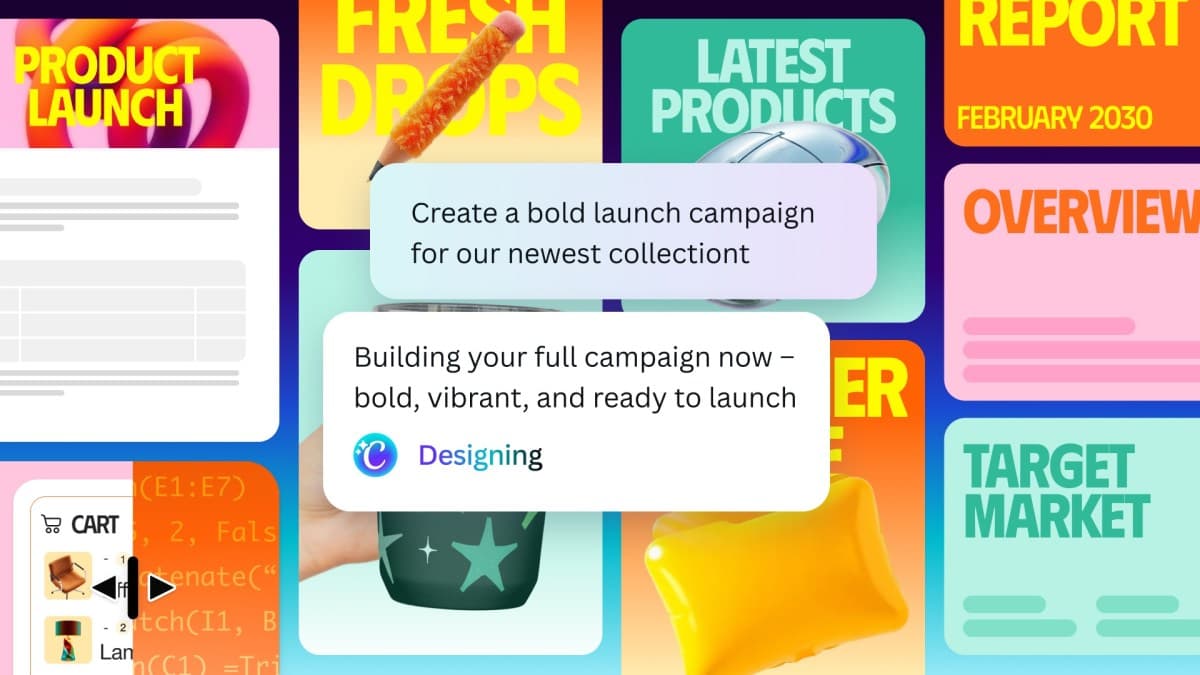
Canva’s AI Assistant Can Now Call Various Tools to Make Designs for You




Why It Matters
The enhanced assistant streamlines end‑to‑end content creation for small businesses and enterprises, reducing manual design steps and accelerating time‑to‑market. Canva’s rapid AI efficiency gains and integration depth position it as a formidable challenger to Adobe and Figma in the design‑software arena.
Key Takeaways
- •Canva AI 2.0 can orchestrate multiple tools via text prompts.
- •New integrations let AI read Slack, Gmail, Drive, Calendar, Zoom data.
- •Enterprise revenue grew 100% YoY; company valued at $42 B.
- •Lucid Origin image model now 5× faster and 30× cheaper.
- •Scheduling feature drafts repeatable posts for user review before publishing.
Pulse Analysis
Canva’s AI 2.0 marks a shift toward truly agentic design assistants, where a single prompt can trigger a cascade of specialized tools—image generation, layout tweaking, and even web research. By layering outputs, the platform preserves editability, a critical advantage for designers who need granular control. This approach mirrors broader AI trends that prioritize workflow orchestration over isolated generation, positioning Canva as a hub that can both consume and produce content across multiple formats.
The rollout’s integration suite—Slack, Gmail, Google Drive, Calendar, and Zoom—turns everyday communication channels into data sources for the assistant. Users can grant the AI access to emails, meeting notes, or shared files, allowing it to auto‑populate designs with brand‑consistent copy or schedule social posts. For small businesses that already rely on Canva for most visual tasks, this reduces the friction of hopping between apps, while the new scheduling draft feature adds a safety net by requiring human approval before publishing.
Competitive pressure is intensifying as Adobe introduced its Firefly assistant and Figma embedded AI agents. Canva’s claim of a 5× speed boost and 30× cost reduction for its Lucid Origin model underscores a strategic focus on efficiency, which could translate into lower subscription fees or higher margins. With enterprise revenue doubling year‑on‑year and a $42 billion valuation, Canva is poised for an IPO, likely next year, and its AI‑centric roadmap may become a key differentiator in the crowded design‑software market.
Canva’s AI assistant can now call various tools to make designs for you
Comments
Want to join the conversation?
Loading comments...