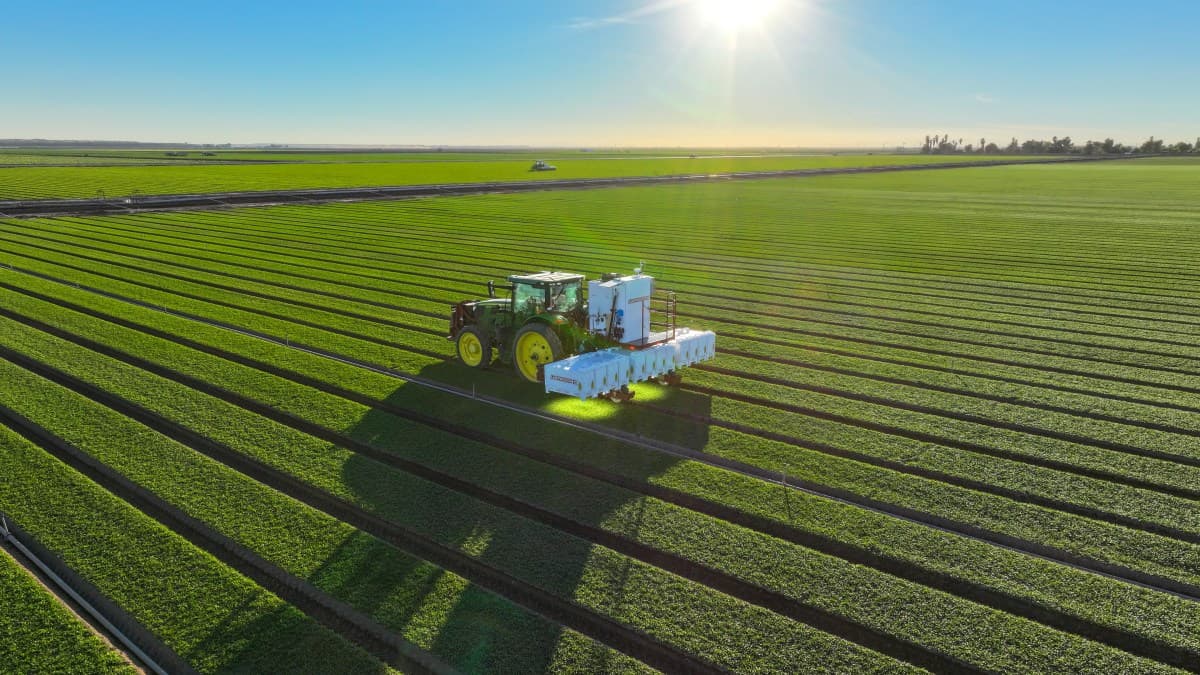
Carbon Robotics Built an AI Model that Detects and Identifies Plants
•February 2, 2026
0

Companies Mentioned


Why It Matters
Instant weed identification reduces downtime and labor, boosting farm productivity and lowering chemical usage. The technology positions autonomous robotics as a scalable solution for sustainable agriculture.
Key Takeaways
- •LPM recognizes plant species instantly, no retraining needed
- •Trained on over 150 million labeled plant images
- •Supports robots on 100 farms across 15 countries
- •Enables farmers to target weeds in real time
- •Reduces labeling cycle from 24 hours to seconds
Pulse Analysis
Precision agriculture has long wrestled with the latency of data labeling, especially for weed control. Traditional robotic weeders required farmers or technicians to manually annotate new species, a process that could stall operations for up to a day. Carbon Robotics, a pioneer in laser‑based weed elimination, tackled this bottleneck by leveraging its extensive field‑collected dataset to train a deep‑learning model capable of generalizing across plant variations. This shift reflects a broader industry trend where AI models are moving from narrow, supervised tasks to more adaptable, zero‑shot recognition capabilities.
The Large Plant Model (LPM) represents a quantum leap in operational efficiency. By ingesting over 150 million images from diverse climates and soil conditions, the model can differentiate crops from weeds and even identify novel species without prior labeling. Farmers now interact with the system through a simple UI, uploading a photo of an unfamiliar weed and instantly instructing the robot to target it. This real‑time feedback loop eliminates the 24‑hour retraining window, translating into immediate cost savings, reduced herbicide application, and higher yields. Moreover, the software‑first deployment means existing fleets can be upgraded without hardware changes, accelerating adoption across Carbon Robotics’ global customer base.
Beyond the immediate benefits, LPM signals a maturation of AI‑driven agritech that could reshape the competitive landscape. With $185 million raised from investors like Nvidia NVentures, the company is poised to expand its data pipeline, further refining model accuracy and extending coverage to a broader spectrum of crops. As farms scale up autonomous operations, the ability to instantly adapt to evolving weed populations becomes a critical differentiator. Stakeholders—from venture capitalists to agribusiness executives—should watch how this technology drives lower input costs, supports sustainability goals, and accelerates the shift toward fully autonomous, data‑rich farming ecosystems.
Carbon Robotics built an AI model that detects and identifies plants
0
Comments
Want to join the conversation?
Loading comments...