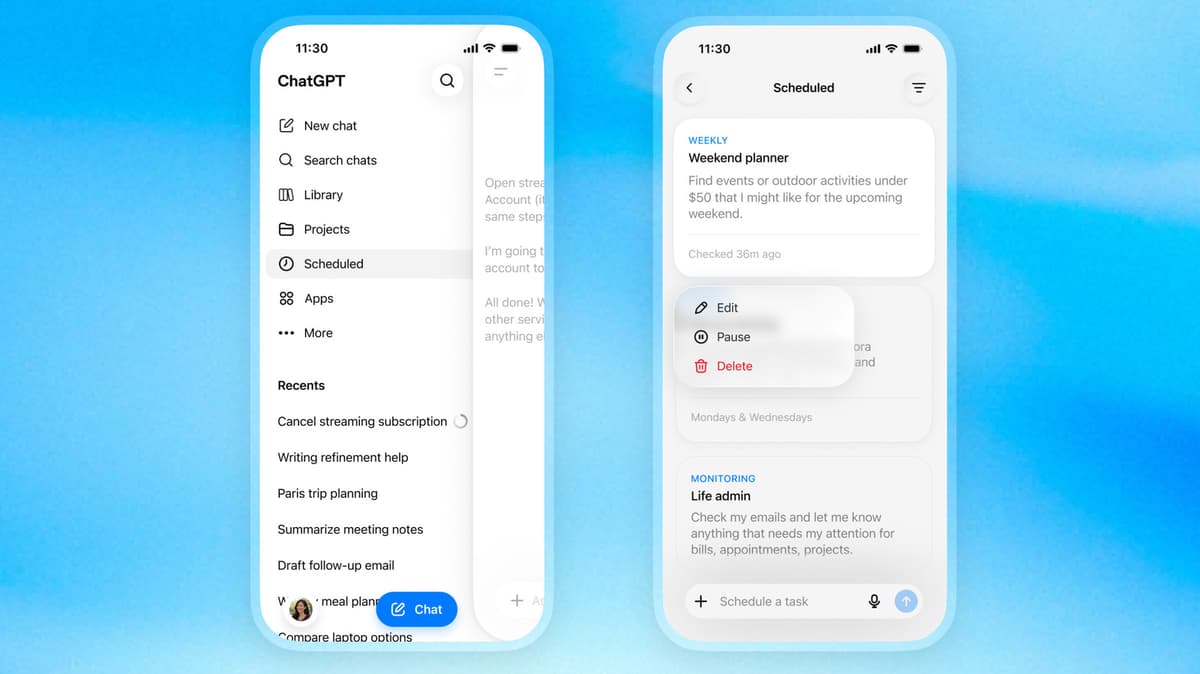
ChatGPT Now Has a Hub for Scheduled Tasks
Why It Matters
Scheduled prompts turn ChatGPT into a proactive assistant, enabling businesses to automate routine queries and monitoring without manual intervention, boosting productivity and data‑driven decision‑making.
Key Takeaways
- •New Scheduled page centralizes future ChatGPT prompts.
- •Users can set exact time or broad time windows.
- •Supports monitoring tasks that browse web or connected apps.
- •Available now for Plus, Pro, Business, Enterprise tiers.
- •Pulse daily summaries discontinued; users shift to scheduling hub.
Pulse Analysis
OpenAI’s latest update adds a dedicated Scheduling hub to ChatGPT, expanding the chatbot’s role from a reactive conversational tool to a proactive task manager. Users can now program prompts to run at a specific hour or within a broader timeframe such as "morning" or "evening," and the interface lets them edit, pause, or delete these jobs with a single click. The rollout, limited to paid tiers—Plus, Pro, Business, and Enterprise—also introduces monitoring tasks that automatically browse the web or linked applications, delivering fresh insights without user prompting. At the same time, OpenAI is retiring Pulse, its personalized daily‑summary feature, nudging users toward the new scheduler for future briefings.
For enterprises, the scheduling capability unlocks a range of automation use cases. Marketing teams can pre‑schedule performance reports, finance departments can trigger end‑of‑day reconciliations, and product groups can set up continuous market‑trend scans that feed directly into internal dashboards. Because the tasks run on OpenAI’s cloud infrastructure, they benefit from the platform’s scaling and the recent performance enhancements that make scheduled jobs faster and more reliable. The ability to define broader time windows also accommodates variable workloads, ensuring that critical queries execute during off‑peak hours to reduce latency.
The move positions ChatGPT against emerging AI‑driven workflow tools from competitors like Microsoft Copilot and Google Gemini, which already offer scheduling hooks within their ecosystems. By bundling the scheduler with its premium plans, OpenAI signals a strategic push to monetize advanced productivity features while keeping the free tier lean. As more businesses adopt AI‑augmented operations, the scheduling hub could become a cornerstone for integrating generative AI into routine processes, paving the way for future expansions such as multi‑step orchestration and deeper app integrations.
ChatGPT now has a hub for scheduled tasks
Comments
Want to join the conversation?
Loading comments...