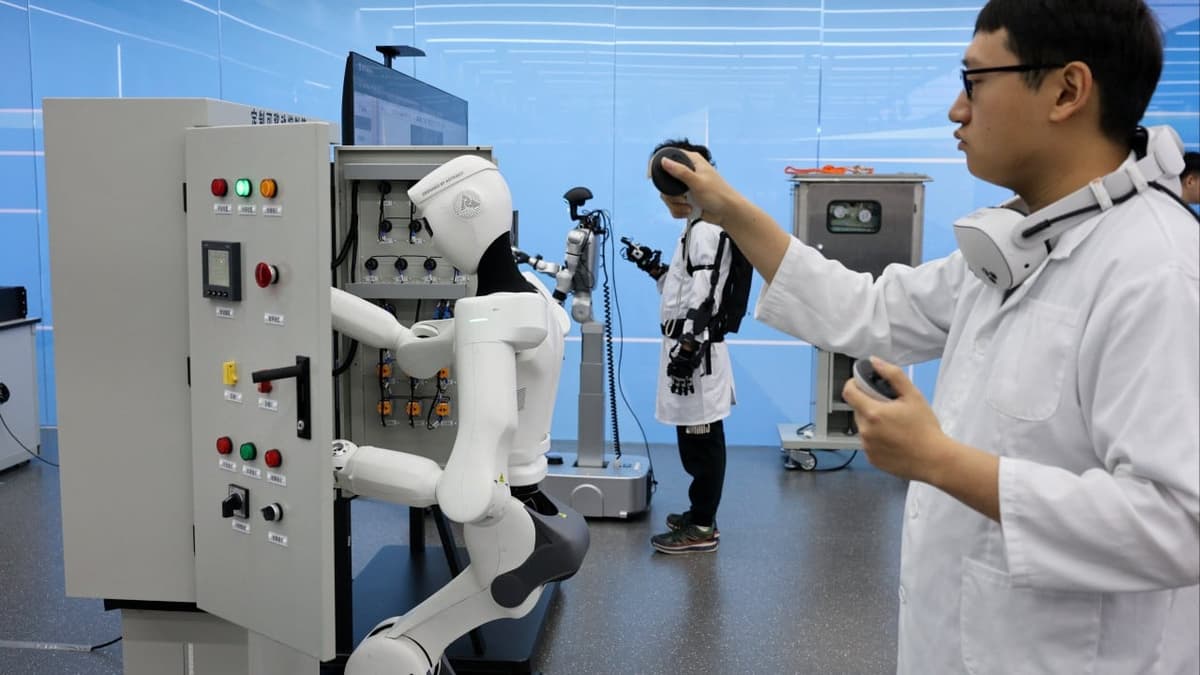
China Plans to Invest Billions on a Robot Army to Run Its Power Grid
Why It Matters
Automating the power grid enhances reliability and safety while cementing China’s leadership in the global AI‑robotics market, reshaping competitive dynamics for utility operators worldwide.
Key Takeaways
- •State Grid allocates 6.8 bn yuan ($1 bn) for AI robots in 2026.
- •Plan includes 5,000 robot dogs for remote substation inspections.
- •Humanoid and dual‑arm robots will service ultra‑high‑voltage lines.
- •Industry investment may exceed 10 bn yuan, boosting domestic robotics share.
- •Chinese robot shipments hit 14,000 units in 2025, fivefold growth.
Pulse Analysis
China’s decision to pour a billion dollars into embodied intelligence reflects a broader trend of utilities turning to autonomous systems for hard‑to‑reach assets. Power grids span vast, often mountainous terrain where human crews face safety risks and high operational costs. AI‑powered robot dogs can navigate these environments, conduct visual and thermal inspections, and relay data in real time, enabling predictive maintenance that reduces outages and extends equipment life. This shift not only improves grid resilience but also creates a data‑rich ecosystem for advanced analytics and grid‑modernization initiatives.
The financial scale of the program signals a maturing domestic robotics supply chain. Companies such as Unitree, Deep Robotics, and UBTech are positioned to capture a majority of the 10 billion‑yuan market, reinforcing China’s 88 percent share of global robot shipments. By allocating roughly 85 percent of the budget to hardware and the remainder to R&D and training, State Grid is fostering rapid iteration and customization of robot platforms. Compared with U.S. firms, which hold a modest three‑percent share, Chinese manufacturers gain a decisive advantage in cost, integration speed, and government backing, potentially reshaping export opportunities in emerging markets like Chile.
Looking ahead, the 2026 rollout could serve as a proving ground for mass‑produced humanoid robots, a milestone analysts predict will unlock broader industrial applications beyond energy. Successful deployment will demonstrate that high‑precision, AI‑driven maintenance can be scaled across critical infrastructure, prompting other sectors—telecom, transportation, and manufacturing—to follow suit. As regulatory frameworks evolve to accommodate autonomous agents on public networks, the convergence of AI, robotics, and energy will likely accelerate, positioning China at the forefront of the next wave of industrial automation.
China plans to invest billions on a robot army to run its power grid
Comments
Want to join the conversation?
Loading comments...