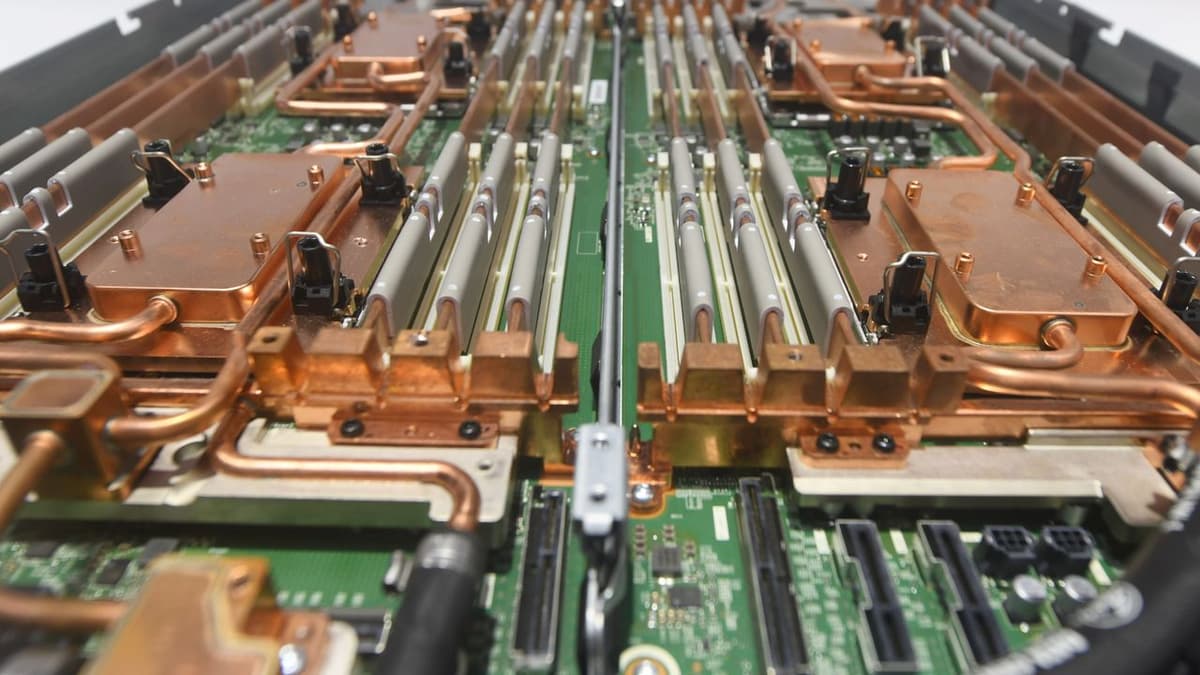
China’s AI Build-Out Forces a Rapid Shift to Liquid Cooling — Massive Clusters Put Pressure on Domestic Suppliers to Shift Cooling Methods
•February 19, 2026
0
Companies Mentioned


Why It Matters
Liquid cooling is essential to sustain China’s AI super‑scale workloads while cutting energy costs, creating a strategic advantage for firms that master the technology.
Key Takeaways
- •China built 42 clusters, >1,590 exaflops capacity.
- •Nvidia Blackwell GPUs exceed 1,000 W per chip.
- •Envicool stock tripled, targeting liquid‑cooling market.
- •Liquid cooling cuts PUE, improves energy efficiency.
- •Domestic firms race to replace Western cooling suppliers.
Pulse Analysis
The surge in AI model size and accelerator density has turned thermal management into a bottleneck for data‑center operators worldwide. Traditional air‑based systems struggle to dissipate the kilowatt‑per‑rack loads generated by next‑generation GPUs such as Nvidia’s Blackwell line. Liquid‑cooling technologies—direct‑to‑chip cold plates, immersion, and spray cooling—offer dramatically higher heat‑transfer coefficients, enabling higher rack densities without proportionally increasing fan power. In China, where the government’s "Eastern Data, Western Computing" initiative pushes massive compute farms into renewable‑rich western provinces, designing facilities around liquid cooling from the ground up eliminates costly retrofits and maximizes energy efficiency.
Policy and economics are converging to accelerate domestic liquid‑cooling capabilities. The Ministry of Industry and Information Technology’s strict Power Usage Effectiveness (PUE) mandates force operators to adopt solutions that lower auxiliary power consumption. Chinese firms such as Envicool, backed by rising analyst price targets, are rapidly expanding product lines that include cold plates, manifolds, and leak‑detection units. This homegrown ecosystem reduces reliance on Western vendors like Vertiv, whose components face export‑control hurdles, and creates a new revenue stream for Chinese hardware manufacturers aligned with AI hyperscalers like Alibaba and Tencent.
Strategically, mastering liquid cooling could become a differentiator in the global AI infrastructure market. Vendors that bundle accelerators, high‑speed networking, and integrated cooling into turnkey rack solutions will win contracts for both training clusters and high‑density inference deployments. As China scales its 1,590‑exaflop compute capacity, even marginal improvements in cooling efficiency translate into substantial energy savings and operational stability. The race to establish a full domestic cooling supply chain not only supports China’s AI ambitions but also reshapes the competitive landscape for data‑center infrastructure worldwide.
China’s AI build-out forces a rapid shift to liquid cooling — massive clusters put pressure on domestic suppliers to shift cooling methods
0
Comments
Want to join the conversation?
Loading comments...