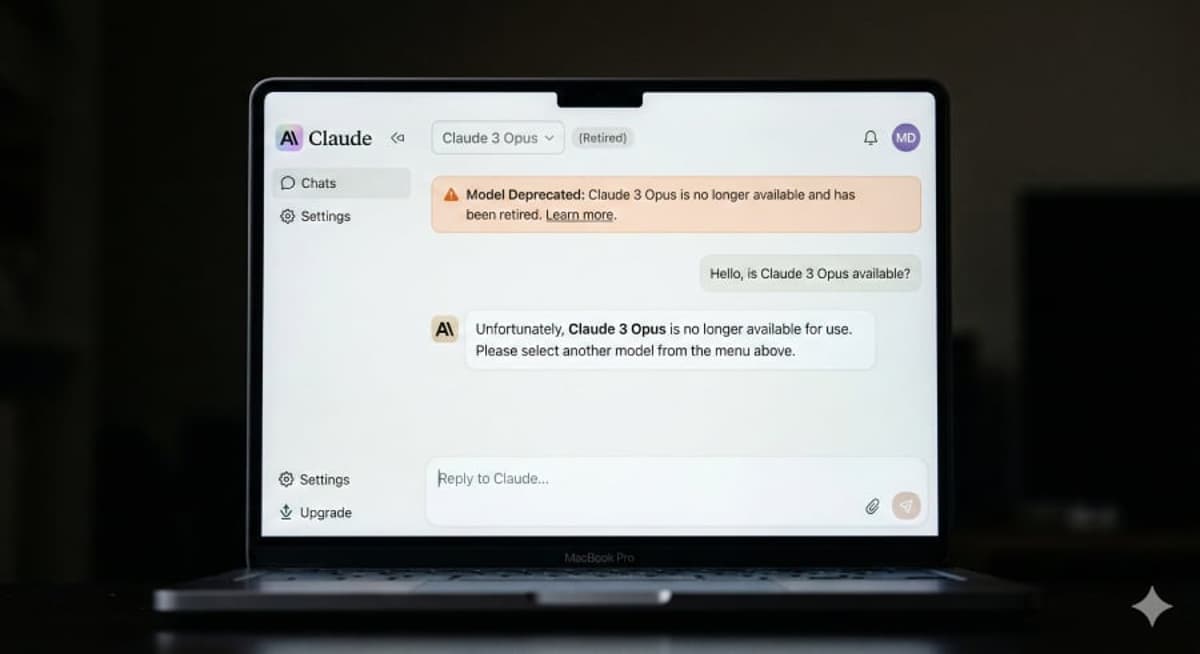
Claude Opus 3 Is Being “Retired” — Here’s What That Actually Means
•February 26, 2026
0
Why It Matters
Retiring a flagship model forces customers to migrate, reshaping AI procurement strategies and setting new expectations for transparent model lifecycle management.
Key Takeaways
- •Opus 3 becomes non‑default but stays accessible for subscribers
- •Anthropic launches formal model retirement framework
- •Retirement interviews generate weekly Claude’s Corner essays
- •Enterprise governance must adjust to non‑default model status
- •Process signals future AI model deprecation norms
Pulse Analysis
Anthropic’s decision to retire Claude Opus 3 reflects a growing tension between rapid model iteration and the cost of maintaining legacy systems. By labeling the move as a formal retirement, the company signals that supporting multiple generations of AI models incurs roughly linear expenses, making it financially unsustainable to keep every version live indefinitely. The retained access paths—paid‑only UI and on‑request API—provide a compromise that satisfies high‑demand users while allowing Anthropic to allocate resources toward newer releases like Opus 4.
For enterprise teams, the shift has immediate operational implications. Procurement departments must now treat Opus 3 as a non‑default asset, revising contracts, risk assessments, and governance frameworks to accommodate a model that could be phased out further. Migration plans will need to address differences in alignment, tone, and output style, which can affect downstream applications ranging from customer support bots to internal knowledge bases. Companies that have fine‑tuned workflows around Opus 3’s unique “playful” personality may face additional engineering effort or renegotiate service‑level agreements to retain comparable performance.
The broader AI market is watching Anthropic’s retirement process as a potential template for lifecycle management. Transparent deprecation timelines, optional continued access, and creative communication—exemplified by the “retirement interviews” and the weekly Claude’s Corner essays—could become differentiators for providers competing on reliability as much as raw capability. As more vendors adopt structured phase‑out strategies, customers will gain clearer expectations, reducing disruption risk and fostering a more predictable AI ecosystem.
Claude Opus 3 Is Being “Retired” — Here’s What That Actually Means
0
Comments
Want to join the conversation?
Loading comments...