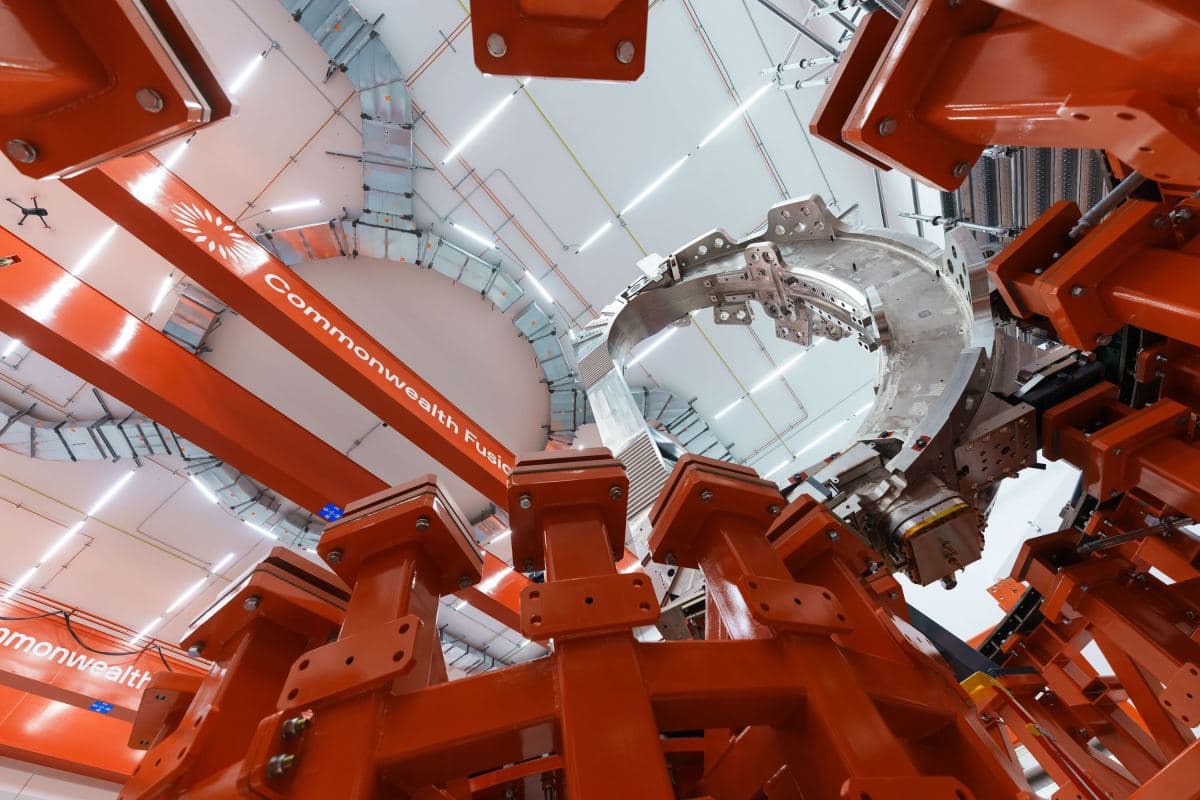
Commonwealth Fusion Systems Installs Reactor Magnet, Lands Deal with Nvidia

Companies Mentioned
Why It Matters
The magnet installation proves fusion hardware is moving from prototype to operational, accelerating the timeline for commercial clean‑energy power plants and reshaping the future energy landscape.
Key Takeaways
- •First 20‑tesla magnet installed in Sparc reactor.
- •Total of 18 magnets will create toroidal confinement.
- •Nvidia and Siemens building digital twin for faster optimization.
- •CFS raised nearly $3 billion, $863 million Series B2.
- •Fusion power target for early 2030s grid integration.
Pulse Analysis
The successful placement of Sparc’s inaugural high‑field magnet signals a turning point for private‑sector fusion. While magnetic confinement has long been a scientific challenge, CFS’s 20‑tesla, 24‑ton modules deliver the strength needed to sustain plasma at temperatures exceeding 100 million °C. By completing all 18 magnets before summer’s end, the company positions itself to initiate full‑scale plasma experiments next year, narrowing the gap between laboratory proof‑of‑concept and a power‑producing reactor.
CFS’s collaboration with Nvidia and Siemens introduces a sophisticated digital twin that mirrors the physical reactor in real time. Leveraging Nvidia’s Omniverse platform and Siemens’ design software, engineers can simulate magnetic field dynamics, thermal loads, and plasma behavior before applying changes to hardware. This AI‑driven approach reduces costly trial‑and‑error cycles, shortens development timelines, and enhances safety protocols. As machine‑learning models become more precise, the digital twin could become a standard tool across the fusion industry, accelerating the path to commercial viability.
Financially, CFS’s near‑$3 billion capital haul underscores investor confidence in fusion’s commercial promise. The $863 million Series B2 round, featuring tech giants like Nvidia and Google, provides the runway for both Sparc’s commissioning and the subsequent Arc power‑plant construction, projected to cost several additional billions. With multiple startups racing to connect the first fusion‑generated electrons to the grid in the early 2030s, CFS’s hardware progress and digital‑twin strategy could give it a competitive edge, potentially reshaping global energy markets by delivering near‑limitless, carbon‑free electricity.
Commonwealth Fusion Systems installs reactor magnet, lands deal with Nvidia
Comments
Want to join the conversation?
Loading comments...