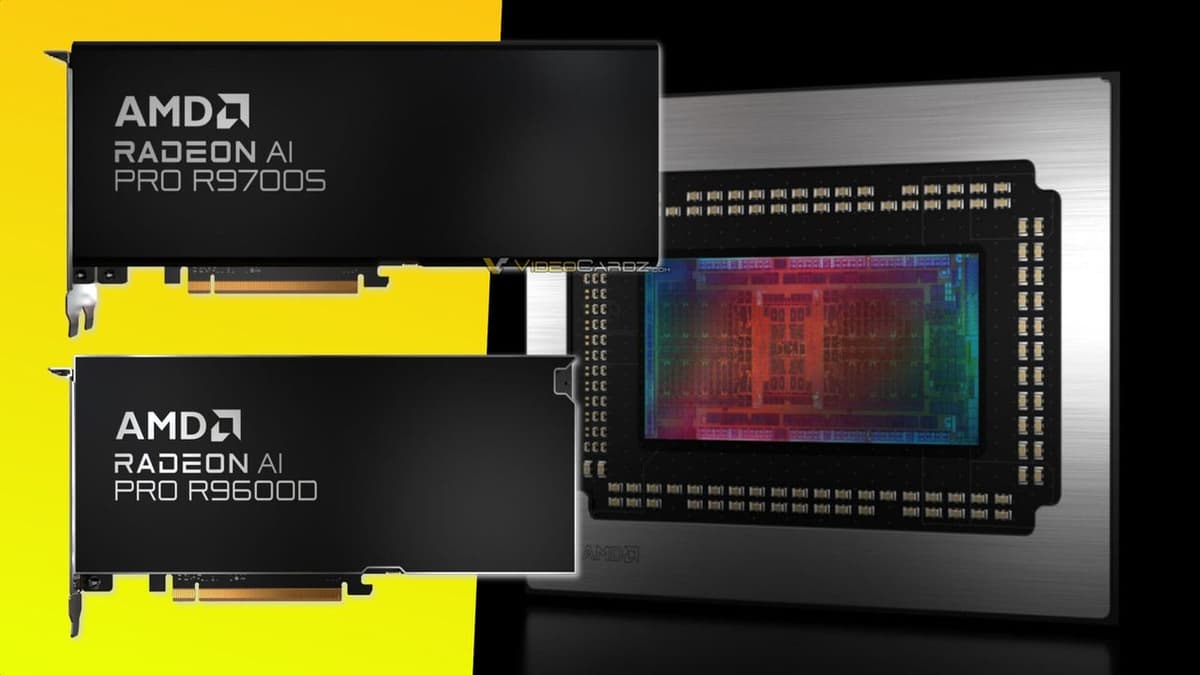
Did AMD Just Launch the Fastest Silent Video Cards Ever? Passively Cooled 32GB DDR6 Radeon AI Pro R9700S Debuts with Ginormous 300W TDP
•December 12, 2025
0
Companies Mentioned

Why It Matters
The R9700S offers enterprise‑grade AI compute without fan noise, expanding AMD’s appeal in quiet, high‑density data‑center and edge deployments. Its performance‑to‑price ratio challenges Nvidia’s premium offerings, potentially reshaping AI accelerator purchasing decisions.
Key Takeaways
- •Passive cooling eliminates fan noise in dense racks
- •32 GB GDDR6 memory targets large AI models
- •47.8 TFLOPS FP32 makes it top‑performing GPU
- •300 W TDP challenges system‑level thermal design
- •PCIe 5.0 x16 ensures bandwidth for generative AI
Pulse Analysis
AMD’s recent unveiling of the Radeon AI PRO R9700S marks a clear pivot toward silent, high‑density compute solutions for enterprise AI. By discarding traditional blower fans and relying on chassis airflow, the card delivers a noiseless operating environment that is attractive for blade servers and tightly packed racks. This design choice aligns with a broader industry trend where data‑center operators prioritize acoustic comfort alongside performance, especially in edge locations or offices where noise can be a compliance issue. The move also differentiates AMD from Nvidia’s fan‑cooled offerings, expanding its product narrative.
The R9700S packs a Navi 48 RDNA4 die with 64 compute units, 4,096 stream processors and a 2,920 MHz boost clock, translating to a peak 47.8 TFLOPS of FP32 throughput. Coupled with 32 GB of GDDR6 on a 256‑bit bus and 64 MB of Infinity Cache, the GPU offers the memory bandwidth required for large language‑model inference and generative‑AI training. PCIe 5.0 x16 connectivity further removes bottlenecks in multi‑GPU configurations, positioning the card as a direct competitor to Nvidia’s H100 in cost‑sensitive deployments while maintaining a 300 W TDP envelope.
Enterprises adopting the R9700S must still address the 300 W power draw, as passive cooling places the thermal burden on chassis airflow and surrounding components. Proper rack design, hot‑aisle containment, and supplemental exhaust fans become essential to avoid throttling during sustained AI inference. Nevertheless, the silent operation and competitive price point open opportunities for AI‑accelerated workloads in environments where noise and power budgets are constrained, such as financial trading floors or edge data centers. AMD’s move signals a maturing AI GPU market where performance, efficiency and acoustic considerations converge.
Did AMD just launch the fastest silent video cards ever? Passively cooled 32GB DDR6 Radeon AI Pro R9700S debuts with ginormous 300W TDP
0
Comments
Want to join the conversation?
Loading comments...