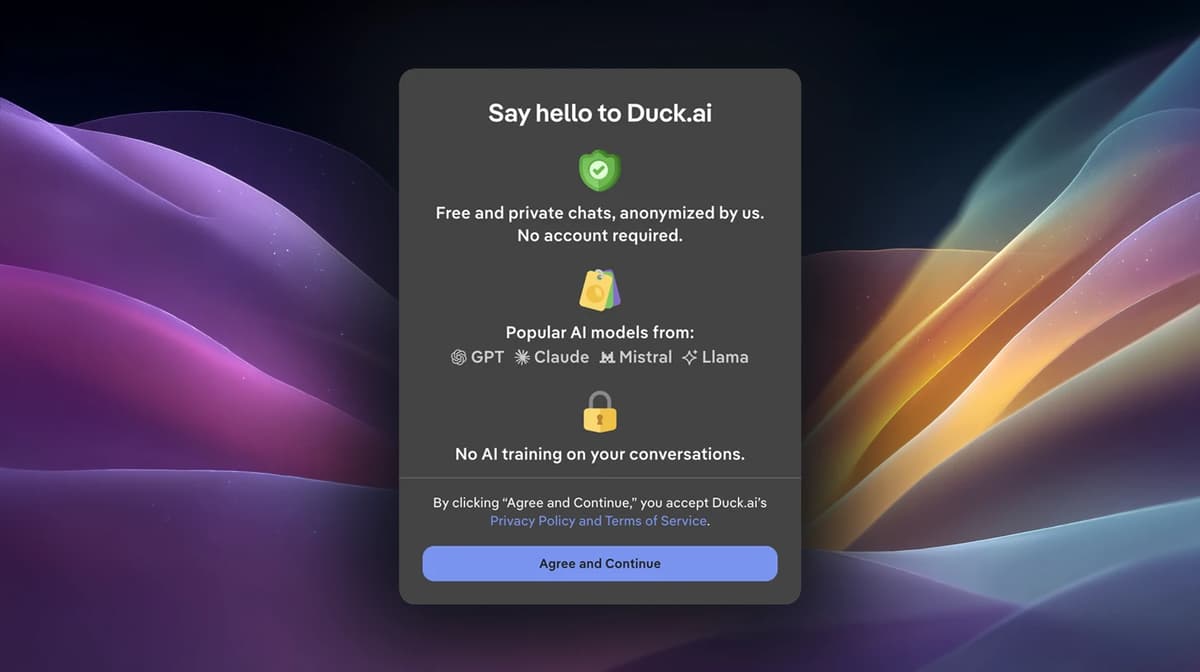
DuckDuckGo Enables AI Voice Chat without Saving Voice Data
•February 10, 2026
0
Why It Matters
The launch reinforces DuckDuckGo’s privacy‑first positioning while expanding AI interaction options, potentially attracting privacy‑concerned users seeking voice assistants. It also pressures competitors to adopt similar no‑storage policies.
Key Takeaways
- •Duck.ai now supports real-time voice chat.
- •Audio streams never stored after session ends.
- •Only OpenAI accesses voice data for response generation.
- •Feature works in DuckDuckGo browser; Mozilla support upcoming.
- •Users can toggle voice chat on or off anytime.
Pulse Analysis
The rise of conversational AI has been dominated by voice assistants that harvest and retain user audio to improve models, raising privacy alarms among consumers and regulators. DuckDuckGo’s decision to embed voice chat within Duck.ai, while explicitly refusing to store any recordings, marks a notable shift toward privacy‑centric AI experiences. By limiting data exposure to the brief moment of processing, the company aligns its product with its broader mission of minimizing digital footprints, offering a compelling alternative for users wary of pervasive surveillance.
Technically, the feature streams audio over encrypted channels directly to OpenAI’s inference servers, where the speech is transcribed and responded to in real time. No intermediate caching occurs, and once the response is delivered, the audio payload is discarded. This architecture satisfies both security best practices and regulatory expectations, such as GDPR’s data minimization principle. The optional toggle in Duck.ai settings gives users granular control, reinforcing trust and allowing enterprises to adopt the tool without compromising internal compliance policies.
From a market perspective, DuckDuckGo’s privacy‑first voice chat could reshape competitive dynamics. As major browsers and search engines race to embed AI assistants, the ability to offer a truly non‑recording voice interface may attract a niche yet growing segment of privacy‑sensitive users and organizations. Competitors may be compelled to adopt similar no‑storage guarantees or risk losing credibility. Looking ahead, broader browser support, especially for Mozilla, will be critical for scaling adoption, while the partnership with OpenAI ensures state‑of‑the‑art language capabilities without sacrificing DuckDuckGo’s core privacy ethos.
DuckDuckGo enables AI voice chat without saving voice data
0
Comments
Want to join the conversation?
Loading comments...