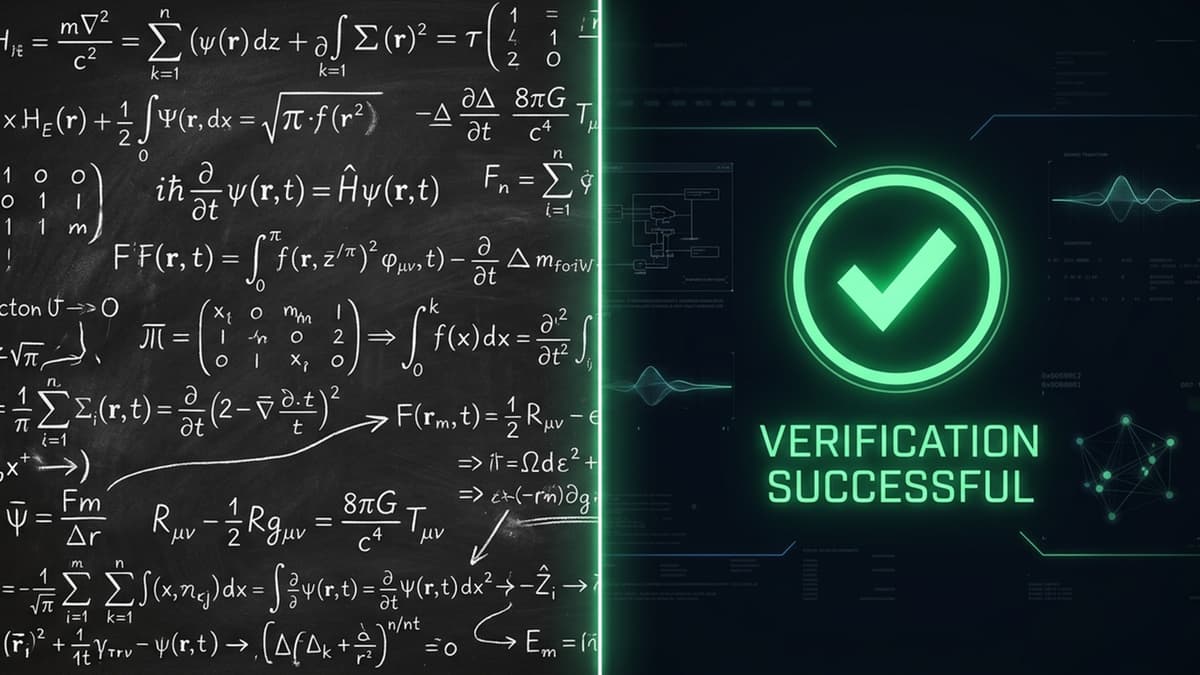
'Essentially No Human Intervention': Chinese AI Solves 12-Year-Old Math Problem in Just 80 Hours — and Even Proves It

Why It Matters
The breakthrough shows that AI can not only discover new mathematical results but also certify them, potentially accelerating research cycles and reducing reliance on expert collaboration. It signals a shift toward more automated, verifiable scientific discovery across technical fields.
Key Takeaways
- •Dual‑agent AI solved a 12‑year‑old algebra conjecture in 80 hours
- •Rethlas generates proofs; Archon formalizes them using Lean 4
- •No human mathematical judgment required during the entire solving process
- •Framework bridges natural‑language reasoning with formal verification for math research
Pulse Analysis
The intersection of artificial intelligence and pure mathematics has long been a frontier of speculation, but recent progress suggests it is becoming a practical reality. Earlier attempts relied on large language models that could suggest proof sketches yet often hallucinated steps, leaving human experts to validate each claim. By contrast, the Peking University team’s system integrates a search‑driven reasoning module, Rethlas, with a formal verification pipeline, Archon, that automatically translates candidate proofs into Lean 4, a proof assistant trusted by the formal methods community. This two‑stage architecture reduces the gap between informal insight and rigorous certification, a hurdle that has traditionally limited AI contributions to mathematics.
Rethlas operates like a theorem‑search engine, pulling from Matlas to explore possible proof strategies, while Archon leverages LeanSearch to construct a Lean 4 project that the theorem prover can check. The dual‑agent design means the AI not only proposes a solution but also validates it against a massive library of existing theorems, ensuring logical consistency without human oversight. The entire workflow completed in roughly 80 hours—far faster than a typical collaborative effort among specialists—demonstrating that AI can handle both the creative and the verification phases of mathematical research.
If the approach scales, it could transform how researchers approach open problems, allowing rapid iteration on conjectures that previously required months of expert labor. Industries that depend on advanced mathematics, such as cryptography, materials science, and quantitative finance, stand to benefit from faster, more reliable proof generation. Nonetheless, the system’s current success on a niche algebraic problem does not guarantee performance on higher‑dimensional or interdisciplinary challenges like the Riemann Hypothesis. Ongoing peer review and broader testing will determine whether this dual‑agent paradigm becomes a staple in the mathematician’s toolkit or remains a specialized proof‑of‑concept.
'Essentially no human intervention': Chinese AI solves 12-year-old math problem in just 80 hours — and even proves it
Comments
Want to join the conversation?
Loading comments...