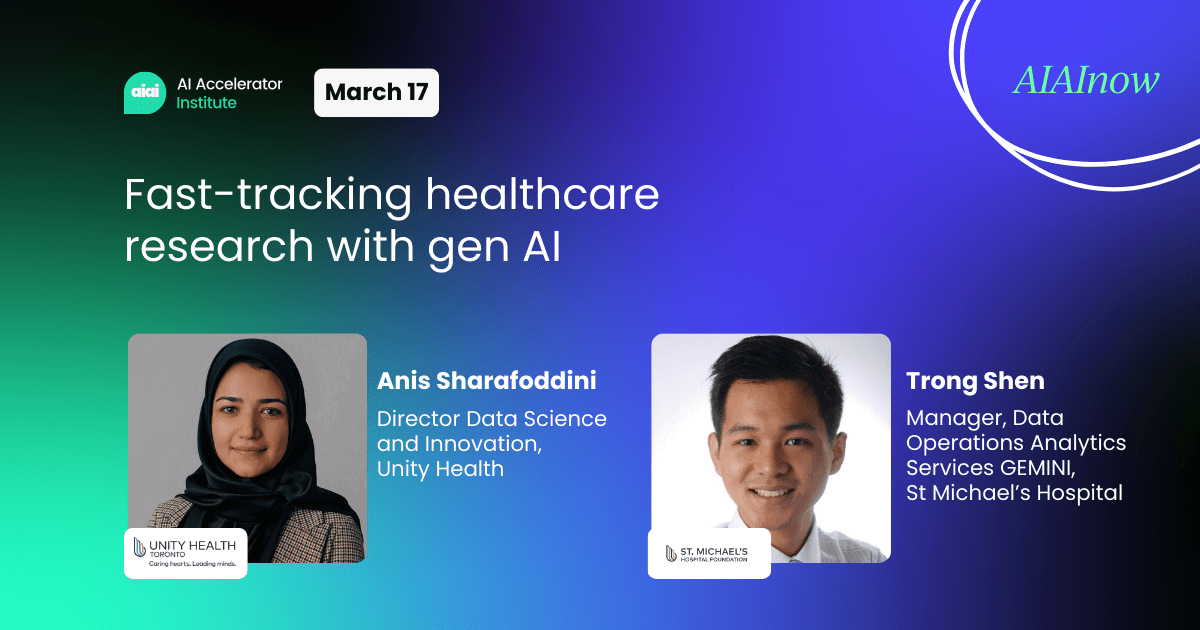
Fast-Tracking Healthcare Research with Gen AI
•March 10, 2026
0
Why It Matters
Integrating GenAI into clinical data pipelines shortens research cycles, improves coding accuracy, and mitigates data scarcity, giving healthcare organizations a competitive edge in innovation and patient outcomes.
Key Takeaways
- •Gemini network leverages GenAI for clinical note analysis.
- •ICD Assist automates preliminary coding, reducing manual effort.
- •RAG and PEFT streamline AI pipeline development.
- •On‑premise solutions address data governance and security.
- •Human‑in‑the‑loop maintains clinical oversight during AI deployment.
Pulse Analysis
Generative AI is reshaping the healthcare landscape by turning vast, unstructured clinical datasets into actionable intelligence. Platforms like Unity Health’s Gemini network illustrate how large‑scale note ingestion combined with advanced language models can surface insights that were previously hidden in paper charts. This shift not only accelerates research timelines but also enables clinicians to query patient records in real time, fostering a data‑driven culture across hospitals and research institutions.
At the core of Gemini’s success are modern AI engineering techniques such as Retrieval‑Augmented Generation (RAG) and Parameter‑Efficient Fine‑Tuning (PEFT). RAG enriches model outputs with up‑to‑date medical literature, while PEFT reduces computational overhead, allowing rapid iteration on domain‑specific tasks like ICD code suggestion. Synthetic data generation further alleviates privacy constraints, providing robust training sets without exposing patient identifiers. Coupled with a human‑in‑the‑loop approach, these tools ensure that AI recommendations are vetted by clinicians and professional coders, preserving clinical accuracy while scaling productivity.
Data governance remains a pivotal concern as health AI matures. Gemini’s on‑premise architecture addresses regulatory demands by keeping sensitive information within secure hospital firewalls, mitigating risks associated with cloud exposure. Robust audit trails, role‑based access controls, and encryption standards empower organizations to comply with HIPAA and emerging AI‑specific guidelines. As more providers adopt similar GenAI frameworks, the industry can expect faster drug discovery, improved diagnostic support, and a new era of collaborative research that balances innovation with patient privacy.
Fast-tracking healthcare research with gen AI
0
Comments
Want to join the conversation?
Loading comments...