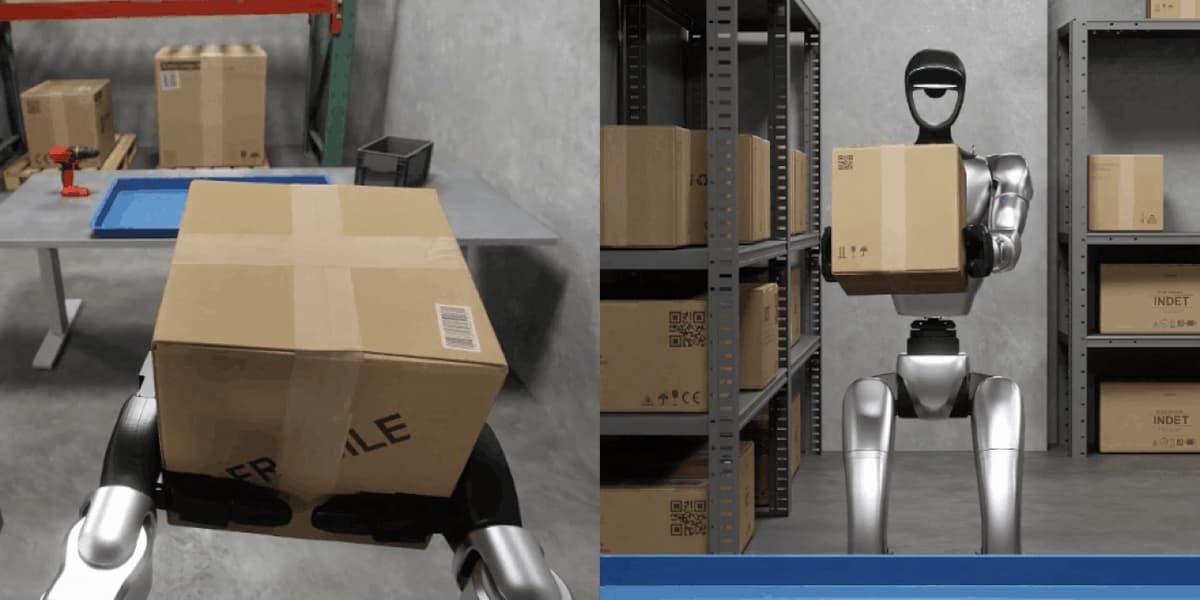
Generalist Robot Policy Evaluation in Simulation with NVIDIA Isaac Lab-Arena and LeRobot
•January 5, 2026
0
Companies Mentioned


Why It Matters
The combined platform lowers barriers to building, testing, and sharing generalist robot policies, accelerating open‑source physical AI adoption across industry and research.
Key Takeaways
- •Isaac Lab‑Arena now in LeRobot EnvHub
- •Pre‑trained GR00T N VLA models available open‑source
- •Supports evaluation on Reachy 2 humanoid robot
- •Over 250 Lightwheel tasks accessible via integration
- •Simplified setup using Conda and NVIDIA Brev GPU instances
Pulse Analysis
The robotics community has long grappled with fragmented tools for simulation, training, and on‑robot inference. By embedding NVIDIA Isaac Lab‑Arena within Hugging Face’s LeRobot EnvHub, developers now enjoy a seamless end‑to‑end workflow that bridges high‑fidelity simulation with real‑world hardware. This integration leverages NVIDIA’s Isaac Sim ecosystem, offering scalable physics and sensor realism, while LeRobot supplies a unified interface for loading environments, datasets, and pretrained vision‑language‑action models such as GR00T N.
Beyond the core simulation engine, the partnership introduces a rich catalog of over 250 Lightwheel‑curated tasks, ranging from household manipulation to complex locomotion scenarios. These tasks are instantly shareable through EnvHub, enabling rapid iteration and reproducibility across teams. The workflow supports direct evaluation on platforms like the Reachy 2 humanoid powered by Jetson Thor, and developers can provision GPU‑accelerated instances via NVIDIA Brev to accelerate large‑scale benchmarking.
For businesses and research labs, this open‑source stack translates into faster time‑to‑value for robot policy development. The lowered entry barrier encourages broader participation, fostering a community‑driven ecosystem where improvements to environments, models, and datasets propagate quickly. As more organizations adopt the combined Isaac‑LeRobot framework, we can expect a surge in transferable robot intelligence, driving commercial applications from warehouse automation to personalized service robots.
Generalist Robot Policy Evaluation in Simulation with NVIDIA Isaac Lab-Arena and LeRobot
0
Comments
Want to join the conversation?
Loading comments...