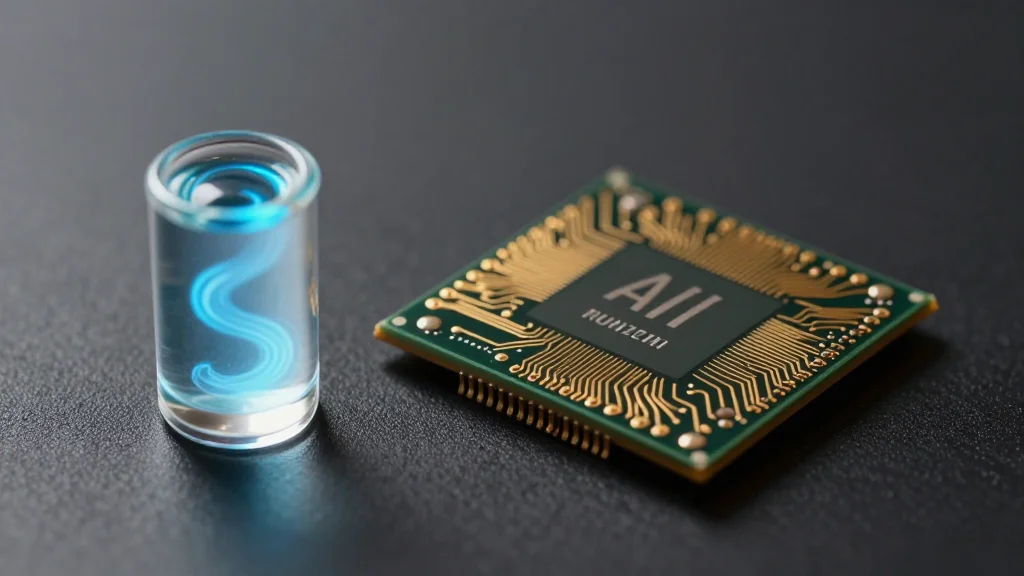
Google AI Breakthrough Means Chatbots Use Six Times Less Memory During Conversations without Compromising Performance

Why It Matters
Six‑times memory efficiency lowers hardware costs and enables more capable AI services, accelerating commercial rollout and competitive pressure on chip makers.
Key Takeaways
- •TurboQuant cuts AI KV cache memory by ≥6× in real time
- •Method combines PolarQuant rotation with Quantized Johnson‑Lindenstrauss optimization
- •Tests show no performance loss on Llama 3.1‑8B, Gemma, Mistral models
- •Memory‑chip stocks dropped after Google’s announcement
- •Benefit applies only to inference; training memory remains unchanged
Pulse Analysis
TurboQuant represents a shift from static model compression to dynamic, on‑the‑fly quantization of the key‑value cache that powers conversational AI. By re‑expressing vector data in polar coordinates (PolarQuant) and fine‑tuning it with a Quantized Johnson‑Lindenstrauss algorithm, Google can retain the same semantic fidelity while storing each token with far fewer bits. The result is a six‑fold reduction in working memory, a metric that traditionally scales linearly with user load and context length, meaning larger prompts can be processed without expanding hardware footprints.
For enterprises and cloud providers, the economic impact is immediate. Memory‑intensive inference has been a cost driver for large language model deployments, prompting data‑center operators to invest in high‑capacity DRAM and emerging HBM solutions. TurboQuant’s efficiency could defer or reduce those capital expenditures, allowing existing servers to host more concurrent sessions or to extend context windows—key for applications like document summarization or multi‑turn dialogue. The announcement rattled shares of SanDisk, Western Digital and Seagate, underscoring how tightly AI performance is linked to the memory supply chain.
However, the breakthrough is limited to inference; training still demands multiple times the memory, so overall data‑center savings will be incremental at first. Adoption will depend on integration into popular model stacks and validation across diverse workloads beyond the benchmark tests cited. As the industry pushes toward ever‑larger models and real‑time AI assistants, techniques like TurboQuant could become a baseline optimization, much like mixed‑precision training did a few years ago. In the near term, expect pilot deployments in cloud AI services, followed by broader rollouts as tooling matures.
Google AI breakthrough means chatbots use six times less memory during conversations without compromising performance
Comments
Want to join the conversation?
Loading comments...