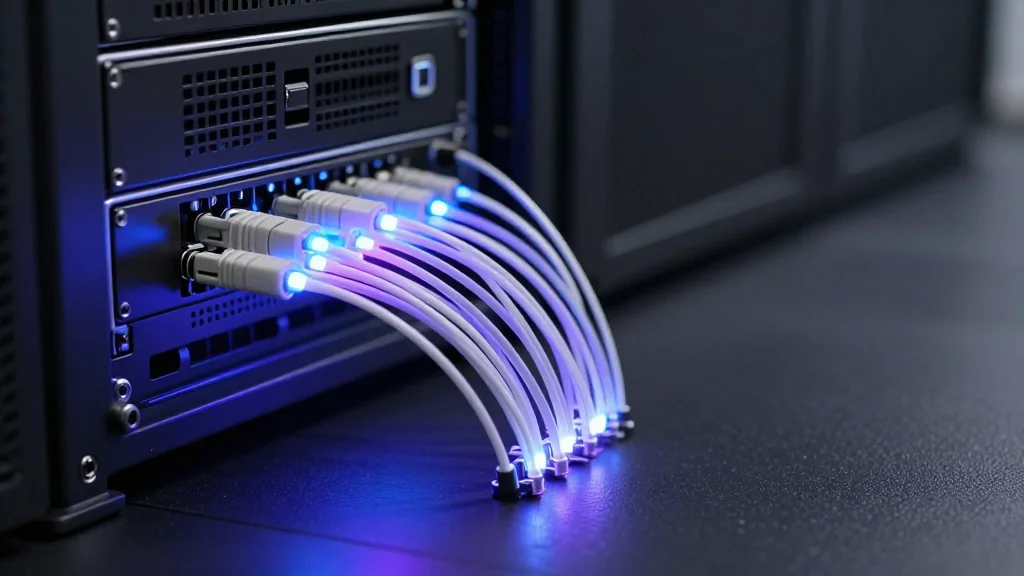
Google Announces Innovations in Mega-Scale Networking for the Agentic Era
Companies Mentioned
Why It Matters
By dramatically boosting inter‑chip bandwidth and providing fault‑tolerant, low‑latency networking, Google positions its cloud as the preferred platform for next‑generation AI agents that require real‑time responsiveness. The accompanying cross‑cloud and data‑layer tools lower integration barriers, accelerating enterprise AI adoption.
Key Takeaways
- •Virgo Network links up to 134,000 chips with 47 Pbps bandwidth.
- •Provides four‑times accelerator bandwidth vs prior generation.
- •Offers sub‑millisecond telemetry and automated fault‑healing.
- •Introduces Agent Gateway for secure cross‑cloud AI traffic.
- •Unified Knowledge Catalog lets AI query data without migration.
Pulse Analysis
Virgo Network represents a paradigm shift in datacenter architecture, moving from hierarchical switches to a flattened fabric that minimizes hop count and latency. By supporting 134,000 chips and 47 petabits per second of bandwidth, the system can keep pace with the massive data movement demands of large language models and multimodal AI pipelines. The built‑in observability and automated routing not only improve uptime but also reduce the operational overhead of managing fault domains at scale, a critical advantage for enterprises running continuous training jobs.
Beyond raw networking, Google’s cross‑cloud strategy targets the practical challenges of deploying agentic AI at enterprise scale. Fluid compute introduces high‑speed CPU instances—C4N and M4N—that deliver up to 95 million packets per second, offering a cost‑effective complement to GPU/TPU clusters for inference and orchestration tasks. The Agent Gateway acts as a security‑first control plane, governing protocols like Model Context and Agent‑2‑Agent, while digital sovereignty features let firms keep encryption keys and models within private enclaves, satisfying regulatory requirements across regions.
The unified data layer and Knowledge Catalog further differentiate Google’s offering by turning siloed data into an AI‑ready knowledge graph. Smart storage annotates files with metadata, enabling agents to perform semantic search and retrieve‑augmented generation without costly data migrations. This end‑to‑end approach—from high‑bandwidth networking to secure, searchable data—creates a compelling value proposition for businesses seeking to operationalize AI agents quickly and reliably. As the AI market matures, such integrated infrastructure could become a decisive factor in cloud provider selection.
Google announces innovations in mega-scale networking for the agentic era
Comments
Want to join the conversation?
Loading comments...