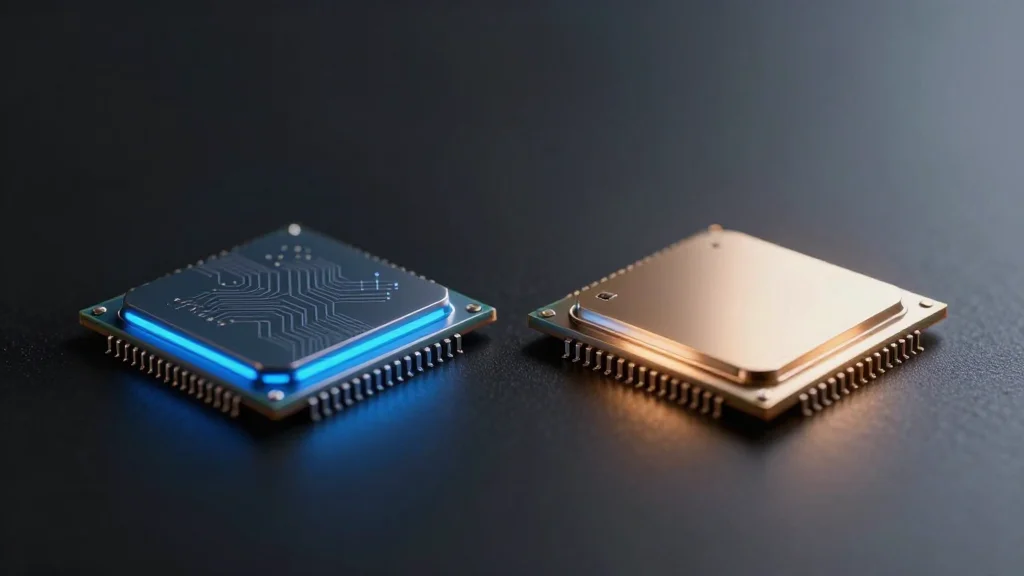
Google Unveils Two New AI Chips For the 'Agentic Era'

Companies Mentioned
Why It Matters
By separating training and inference workloads, Google aims to lower latency and cost for massive AI‑agent deployments, sharpening its competitive edge against Nvidia in a fast‑growing market.
Key Takeaways
- •Training TPU 2.8× faster than Ironwood at same price
- •Inference TPU 8i delivers 80% performance boost over Ironwood
- •Both chips include 384 MB SRAM, triple Ironwood’s capacity
- •Design targets low‑latency, high‑throughput for millions of AI agents
- •Google aims to compete with Nvidia in AI hardware market
Pulse Analysis
Google’s latest hardware announcement reflects a strategic pivot in the AI chip landscape. Historically, Google’s TPUs have been versatile, handling both model training and inference on a single die. The new split‑architecture—one chip optimized for the heavy matrix multiplications of training, another for the low‑latency demands of inference—mirrors a broader industry trend toward specialization. By delivering a 2.8‑fold performance uplift over the Ironwood generation for training and an 80 percent boost for inference, Google positions its silicon as a cost‑effective alternative for enterprises scaling AI workloads, especially as the number of autonomous agents proliferates.
Technical details underscore the competitive intent. Each processor integrates 384 megabytes of SRAM, tripling the on‑chip memory of Ironwood and matching the memory strategy of rivals like Cerebras and Nvidia’s upcoming Groq 3 LPU. The abundant SRAM reduces data movement latency, a critical factor when serving millions of concurrent agents. While Google has not published head‑to‑head benchmarks against Nvidia’s H100 or A100, the performance‑per‑dollar narrative suggests a deliberate effort to erode Nvidia’s market share in both cloud and edge AI deployments.
The implications for the AI ecosystem are significant. Lower‑latency inference chips enable real‑time decision‑making for applications ranging from autonomous robotics to personalized digital assistants, accelerating the rollout of what Sundar Pichai calls the "agentic era." For developers, a dedicated inference TPU could mean reduced operational costs and simplified scaling on Google Cloud. As AI agents become more ubiquitous, hardware that can efficiently train ever‑larger models while simultaneously serving them at scale will be a decisive factor in determining market leadership, and Google’s bifurcated TPU strategy is a clear bet on that future.
Google Unveils Two New AI Chips For the 'Agentic Era'
Comments
Want to join the conversation?
Loading comments...