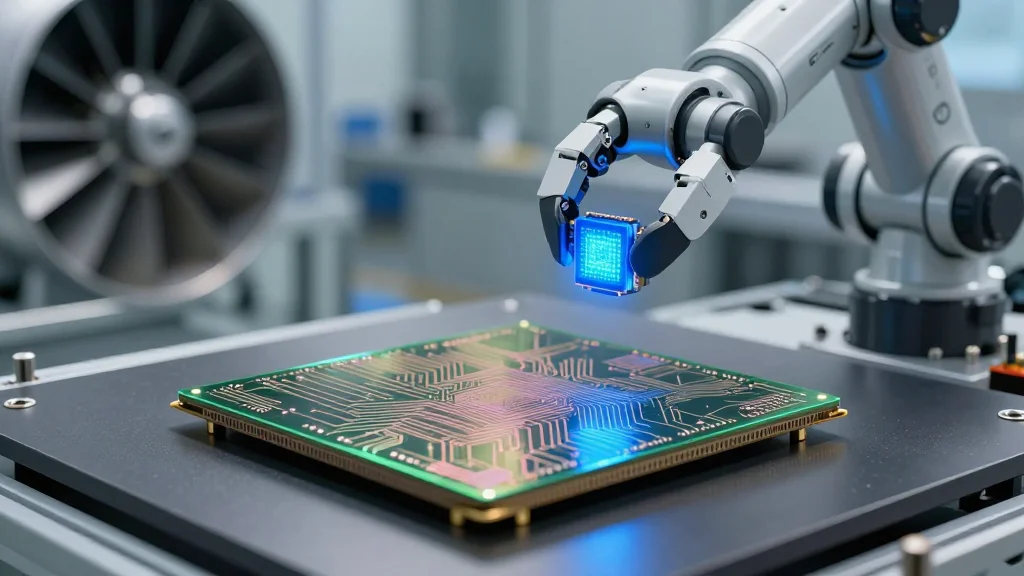
Hitachi and Intel Explore New Physical AI Applications Across Critical Industries
Why It Matters
Combining Hitachi’s operational technology with Intel’s advanced computing accelerates the industrial‑scale rollout of physical AI, giving both firms a competitive edge in high‑growth sectors such as semiconductor manufacturing and quantum technologies.
Key Takeaways
- •Hitachi and Intel partner on physical AI across five strategic pillars
- •Collaboration targets semiconductor yield, quantum R&D, and energy optimization
- •Hitachi’s HMAX Energy to manage power in Intel fabs using high‑voltage chips
- •Joint effort aims to modernize manufacturing, mobility, and energy infrastructure
- •Partnership leverages Hitachi’s OT expertise with Intel’s silicon and AI chips
Pulse Analysis
Physical AI—where artificial intelligence directly interacts with real‑world hardware—has moved from concept to commercial reality, driven by the need for smarter factories, autonomous machines and resilient energy grids. Hitachi, a leader in operational technology, and Intel, a silicon powerhouse, are uniquely positioned to fuse data‑rich OT environments with next‑generation compute. Their collaboration signals a broader industry shift toward embedding AI at the edge, where latency, reliability and security are paramount. By aligning their roadmaps, the two giants can accelerate the development of custom silicon and edge‑AI chips that process sensor data in real time, a capability essential for autonomous robotics and advanced manufacturing.
The partnership’s five strategic pillars translate into concrete initiatives. In semiconductor fabs, Hitachi’s ExTOPE platform will feed high‑precision metrology data into Intel’s AI‑optimized silicon, enabling predictive maintenance that lifts yields and shortens time‑to‑market. Joint quantum‑computing R&D promises to unlock new algorithms for material science and logistics, while the HMAX Energy system—deployed in Intel’s own factories—will use high‑voltage chips to cut power waste and improve grid stability. Custom silicon projects and factory‑automation solutions will further integrate AI into production lines, delivering tighter quality control and lower operating costs.
For the market, the alliance creates a formidable challenger to other industrial AI consortia and reinforces the strategic importance of cross‑domain expertise. Hitachi reported FY2025 revenue of roughly $68 billion, underscoring its scale, while Intel’s $55 billion market cap provides deep capital for silicon R&D. Together they can capture a growing share of the projected $200 billion industrial AI market by 2030. Investors and industry leaders should watch how this collaboration influences standards for edge AI, drives adoption of quantum‑enhanced workflows, and reshapes the competitive dynamics of digital infrastructure providers.
Hitachi and Intel Explore New Physical AI Applications Across Critical Industries
Comments
Want to join the conversation?
Loading comments...