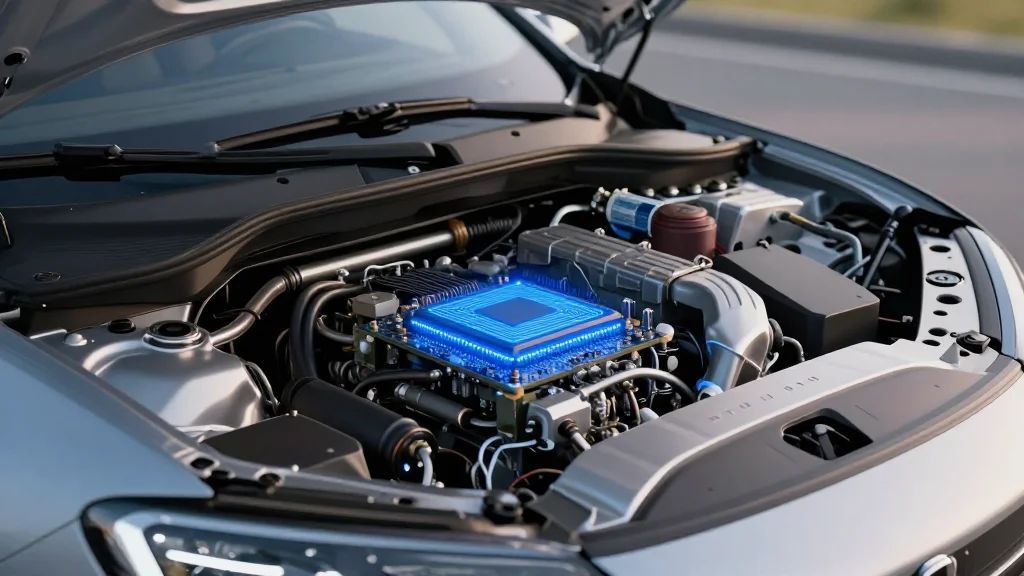
Honda Considers an Analog Spin for Software-Defined Vehicles
Why It Matters
The collaboration could dramatically lower the energy and cost barriers to deploying AI‑driven autonomy in vehicles, giving Honda a competitive edge as the auto industry accelerates toward fully software‑defined platforms. It also showcases a broader shift toward analog and neuromorphic computing for automotive workloads, challenging the dominance of traditional GPU‑centric designs.
Key Takeaways
- •Honda partners with Mythic to develop analog compute-in-memory SoC.
- •Analog SoC promises up to 100× energy efficiency vs GPUs.
- •120 million TOPS per watt claimed, cutting autonomous driving power use.
- •Honda shifts focus after $1.7 billion EV write‑off.
- •Mythic’s $125 million funding round includes Honda and Lockheed Martin.
Pulse Analysis
Analog compute‑in‑memory (CIM) technology represents a departure from the classic von Neumann architecture that separates processing and storage. By performing calculations directly within memory cells, CIM chips can eliminate the costly data shuttling that dominates power budgets in conventional GPUs. Mythic’s approach, which treats memory as tunable resistors, promises up to 120 million trillion operations per second per watt—roughly a hundredfold efficiency gain. For automotive manufacturers, this translates into lighter cooling systems, smaller battery draw, and the ability to run sophisticated neural‑network models for perception and decision‑making without compromising vehicle range.
The automotive sector is increasingly viewing software as a differentiator, with software‑defined vehicles (SDVs) at the forefront of the next wave of innovation. Energy‑intensive AI workloads, such as high‑resolution image processing for lidar and camera fusion, have traditionally required powerful GPUs that strain vehicle power architectures. An analog CIM SoC could lower the total cost of ownership for autonomous driving stacks by reducing both hardware expenses and energy consumption. Moreover, the technology aligns with broader industry trends toward edge AI, where processing must occur locally in real time, free from latency‑prone cloud dependencies.
Honda’s pivot comes after a $1.7 billion write‑off on its 0 Series EV program, prompting the automaker to reassess its technology roadmap. By investing in Mythic’s analog silicon and securing a seat on its latest $125 million funding round, Honda signals confidence in emerging compute paradigms that could future‑proof its SDV ambitions. The partnership also underscores a growing willingness among legacy OEMs to collaborate with venture‑backed chip startups, accelerating the adoption of neuromorphic and analog solutions that may redefine automotive computing in the coming decade.
Honda considers an analog spin for software-defined vehicles
Comments
Want to join the conversation?
Loading comments...