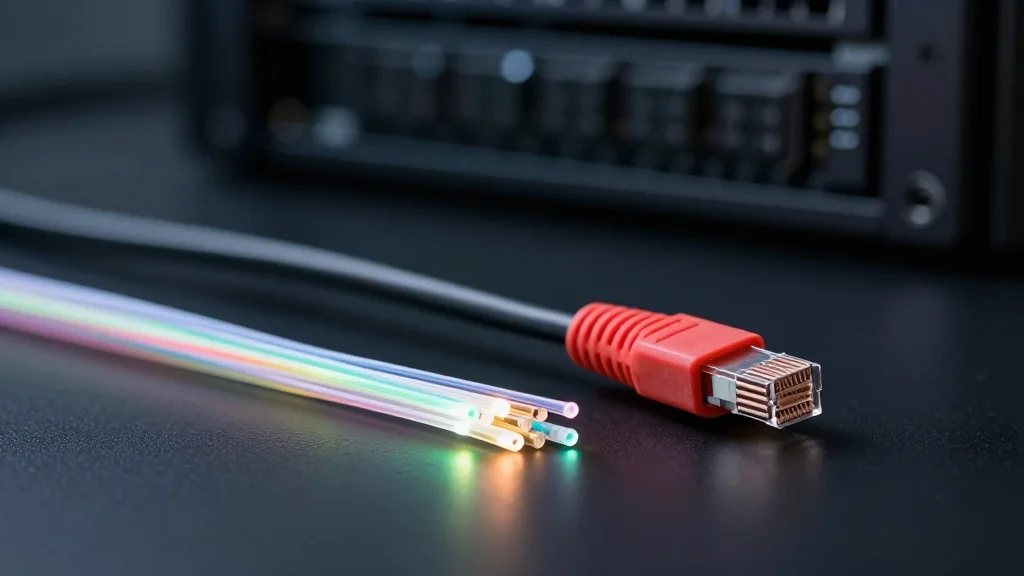
How AI Is Reshaping Copper, Fiber Networking
Companies Mentioned
Why It Matters
Balancing copper’s efficiency with fiber’s reach directly impacts data‑center operating costs and energy footprints, a critical factor as AI workloads explode. The trade‑off shapes infrastructure investments and influences the competitive dynamics of networking vendors.
Key Takeaways
- •Copper handles short‑range links with near‑zero power draw
- •Fiber supports long‑distance, high‑capacity AI traffic but uses more power
- •Co‑packaged optics cut fiber port power from 20W to ~5W
- •Passive copper caps at ~200 Gb/s per lane over 2‑3 m
- •AI data centers blend copper and fiber to balance cost, efficiency
Pulse Analysis
The surge in artificial‑intelligence workloads has turned data‑center networking into a strategic battleground. Training large language models and running inference at scale generate terabytes of traffic that must traverse racks, rows, and even entire facilities. While traditional Ethernet copper cables excel in cost and power efficiency, their signal integrity degrades sharply beyond a few meters at the 200 Gb/s per‑lane rates now common in AI accelerators. Consequently, designers must allocate copper for intra‑rack GPU clusters while reserving fiber for inter‑rack and inter‑hall links, where distance and bandwidth dominate.
Power consumption emerges as a decisive metric in this equation. Optical transceivers can draw up to 20 watts per 1.6 Tb/s port, a figure that balloons across thousands of connections in a hyperscale AI hub. By contrast, copper’s near‑zero draw translates into tangible OPEX savings, especially under tight sustainability mandates. However, fiber’s superior reach and immunity to electromagnetic interference make it indispensable for scale‑out architectures. The resulting hybrid topology forces operators to balance upfront capital costs—fiber’s higher price and fragility—against long‑term energy expenditures and performance requirements.
Innovation is narrowing the gap. Co‑packaged optics, championed by firms like Point2, integrate the optical engine directly onto switch ASICs, truncating the electrical path and slashing power use to roughly five watts per port. This advancement not only curtails energy bills but also eases thermal design constraints, enabling denser rack deployments. As AI continues to drive data‑center expansion, the coexistence of copper and fiber—augmented by next‑generation optical integration—will dictate the economics and scalability of future compute farms.
How AI is reshaping copper, fiber networking
Comments
Want to join the conversation?
Loading comments...