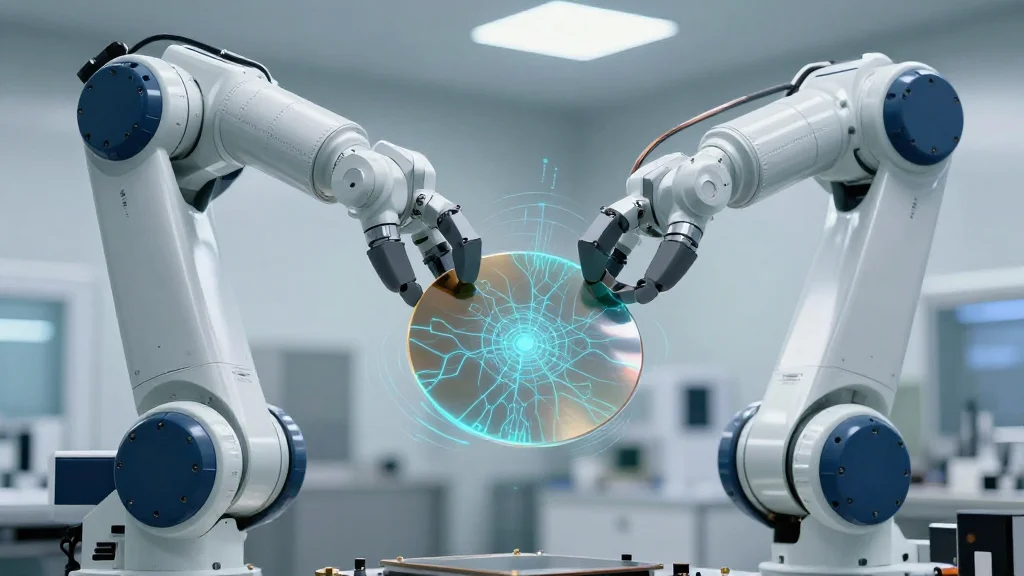
How AI Is Transforming the Factory Floor
Companies Mentioned

Why It Matters
The shift to on‑site AI reduces latency, boosts yield and safety, and positions AI as a foundational layer of modern manufacturing, accelerating competitive advantage across sectors.
Key Takeaways
- •Industrial robots reached 4.66 million units in 2024, up 9%.
- •Asia accounted for 74% of new robot deployments last year.
- •GlobalFoundries scales AI via repeatable, cross‑fab use‑case selection.
- •Intel leverages petabyte‑scale data pipelines for predictive die screening.
- •Two emerging AI architectures: sensor‑tight coupling and full‑stack data aggregation.
Pulse Analysis
The factory floor is undergoing a quiet but profound digital overhaul. AI‑enabled vision systems, collaborative robots and autonomous guided vehicles now capture and process data at the point of production, turning raw sensor streams into actionable insights in milliseconds. The International Federation of Robotics reported 4.66 million operational industrial robots in 2024, a 9 % rise year‑over‑year, with Asia responsible for 74 % of new deployments. This surge reflects a broader migration from cloud‑centric analytics to edge AI, where processing happens on‑site, reducing latency, improving safety and unlocking real‑time defect detection and predictive maintenance.
Semiconductor manufacturing illustrates how AI scaling can differ by business model. GlobalFoundries, a pure‑play foundry, treats AI as a repeatable service, emphasizing cross‑fab portability and disciplined use‑case selection to guarantee measurable ROI. Intel, an integrated device manufacturer, exploits its end‑to‑end visibility, building petabyte‑scale pipelines that feed predictive die‑screening and early‑failure alerts directly into the fab’s control loop. Although the approaches appear divergent—one cautious, one data‑heavy—they are converging as both firms recognize AI as core infrastructure rather than a peripheral analytics add‑on, accelerating yield improvements across the industry.
The rapid adoption of AI has also sparked architectural diversity. Vendors are splitting between tightly coupled sensor‑AI stacks that extract novel physical insights and broader data‑centric platforms that aggregate existing fab telemetry. This split extends to silicon choices, with edge processors and heterogeneous chips moving closer to the machine. Complementary technologies such as digital twins from Siemens and Nvidia, and XR collaborations like the EU’s MASTER project, are further blurring the line between physical and virtual shop floors. As these ecosystems mature, manufacturers can expect a multi‑layered AI landscape that balances practical reliability with ambitious, next‑generation capabilities.
How AI Is Transforming the Factory Floor
Comments
Want to join the conversation?
Loading comments...