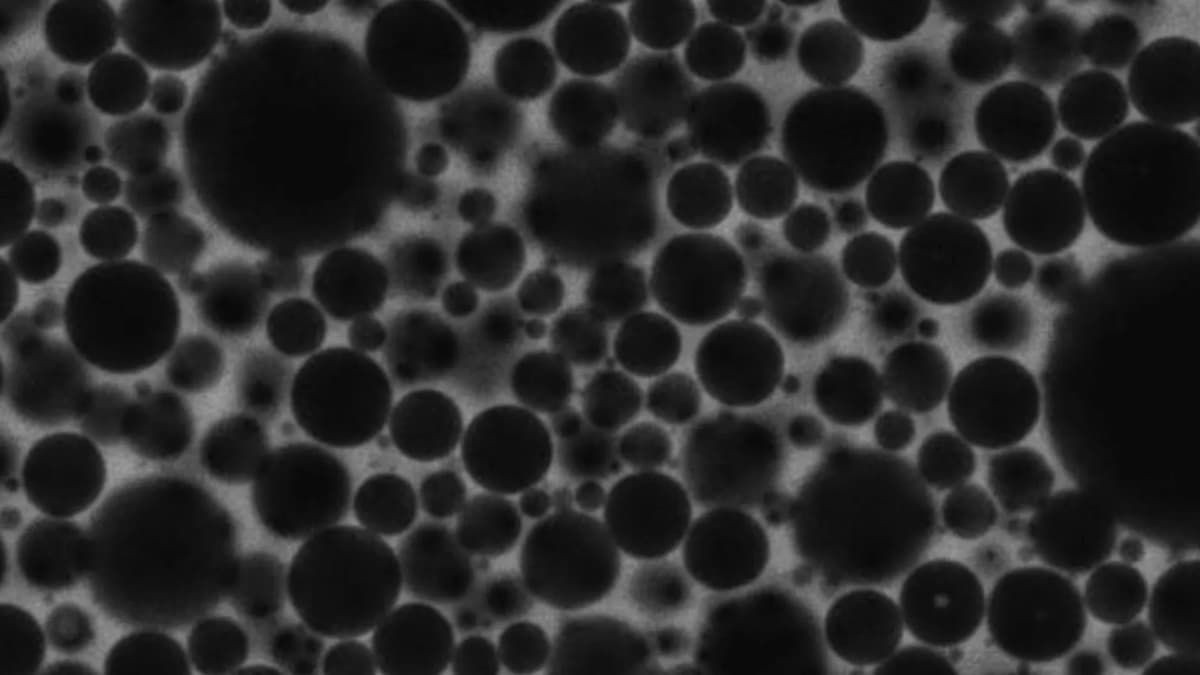
How Everyday Foam Reveals the Secret Logic of Artificial Intelligence
•January 15, 2026
0
Why It Matters
The finding links material physics to artificial‑intelligence theory, offering a blueprint for adaptive, AI‑inspired materials and deeper understanding of dynamic biological structures.
Key Takeaways
- •Foam bubbles continuously reorganize, never settle
- •Motion follows same mathematics as deep learning optimization
- •Study challenges long‑standing static‑foam theory
- •Insight may enable adaptive, AI‑inspired material design
- •Findings could illuminate cellular cytoskeleton dynamics
Pulse Analysis
Foams have long served as convenient analogues for complex, dense materials because their macroscopic solidity masks a rich internal landscape of bubbles and liquid films. Traditional models treated these bubbles as particles trapped in deep energy wells, akin to rocks settling in a valley, which explained the apparent stability of everyday foams. The University of Pennsylvania team, however, used high‑resolution simulations to reveal that bubbles perpetually explore a flat, high‑dimensional configuration space, never reaching a fixed state. This dynamic view reframes foams from static scaffolds to living systems that continuously reorganize.
The same mathematical framework that describes this endless rearrangement mirrors the optimization processes at the heart of deep‑learning neural networks. Gradient‑descent algorithms guide AI models toward broad, flat minima where many parameter sets perform similarly, avoiding over‑fitting to narrow, deep valleys. By mapping foam bubble trajectories onto this landscape, researchers demonstrate that physical systems can exhibit learning‑like behavior without any explicit computation. This cross‑disciplinary parallel suggests that the principles governing generalization in AI may also dictate how materials dissipate energy and maintain resilience under stress.
Recognizing foams as natural embodiments of learning dynamics has practical implications for next‑generation materials engineering. Designers could harness these principles to create composites that self‑adjust their microstructure in response to external stimuli, much like an AI model refines its weights during training. Moreover, the analogy extends to biological structures such as the cellular cytoskeleton, which must balance structural integrity with constant remodeling. By applying deep‑learning mathematics to material science, industries ranging from aerospace to consumer goods can envision products that are both robust and adaptively soft, ushering in a new era of intelligent, responsive materials.
How everyday foam reveals the secret logic of artificial intelligence
0
Comments
Want to join the conversation?
Loading comments...