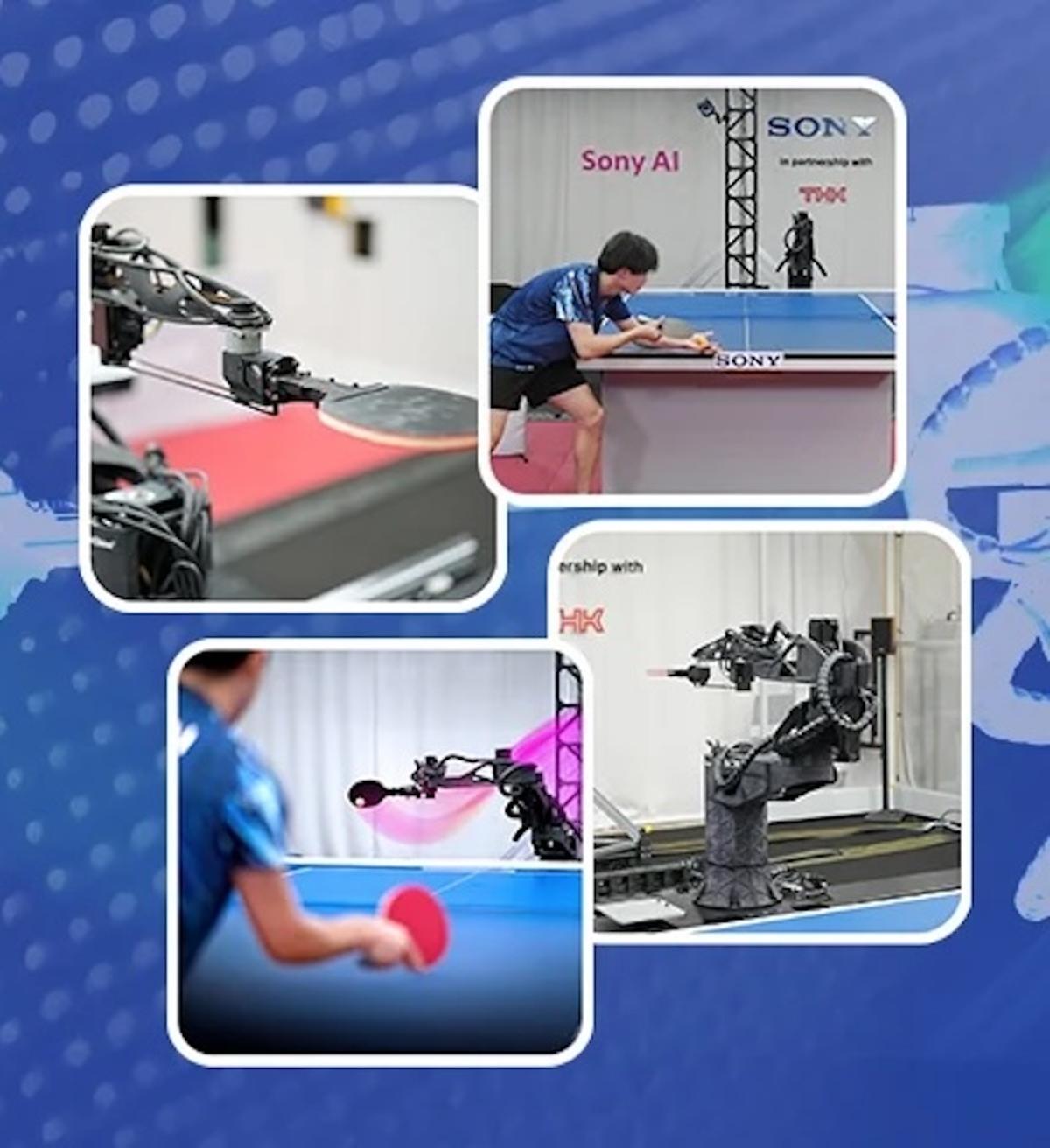
How Sony AI’s Table Tennis Robot Is Advancing Physical AI
Why It Matters
Ace demonstrates that advanced AI‑driven robotics can meet the split‑second decision‑making required in dynamic environments, signaling a shift toward more adaptable automation in industry.
Key Takeaways
- •Sony AI's Ace beat seven ranked players, including former world No.5
- •Improvements stemmed from larger neural nets and refined reinforcement learning
- •Simulation-to-reality training cut perception latency to 8.5 ms
- •Hardware upgrades reduced weight and boosted motor acceleration
- •Advances illustrate physical AI potential for factories and warehouses
Pulse Analysis
Table tennis may seem a niche sport, but its rapid pace and unpredictable ball trajectories make it an ideal crucible for testing physical AI. Unlike static assembly lines, a table‑tennis match demands simultaneous visual processing, trajectory prediction, and precise motor execution within fractions of a second. Researchers therefore treat the game as a microcosm of real‑world challenges—where robots must interpret noisy sensor data, anticipate future states, and adapt actions on the fly. This benchmark pushes the envelope of what autonomous systems can achieve beyond controlled environments.
Sony AI’s Ace leverages a multi‑layered approach to conquer these hurdles. By expanding the size of its deep neural networks and fine‑tuning reinforcement‑learning objectives toward anticipation rather than reaction, the robot learned nuanced spin and speed patterns in a high‑fidelity simulation before transferring skills to the physical table. Parallel hardware upgrades—topology‑optimized frames, higher‑torque motors, and perception pipelines trimmed from 10 ms to 8.5 ms—provided the mechanical bandwidth needed to act on its predictions. The result is a system that not only wins against professional players but also showcases a scalable pipeline for training robots in virtual environments before real‑world deployment.
The implications extend far beyond sport. Factories, warehouses, and logistics hubs increasingly require robots that can navigate cluttered, ever‑changing spaces, handle delicate objects, and collaborate safely with humans. The perception‑planning‑control loop refined in Ace offers a template for such applications, promising faster response times and more resilient operation under uncertainty. As companies adopt similar simulation‑first strategies, the competitive edge will shift toward firms that can integrate large‑scale AI models with optimized hardware, accelerating the transition from rigid automation to truly adaptive, physical AI across the supply chain.
How Sony AI’s table tennis robot is advancing physical AI
Comments
Want to join the conversation?
Loading comments...