Key Takeaways
- •Vector search relies on normalized embeddings and cosine similarity dot product.
- •NumPy can index and query vectors in milliseconds without external libraries.
- •Clustered embeddings group similar products, enabling semantic retrieval.
- •PCA projection visualizes high‑dimensional space and confirms cluster separation.
- •Swap simulated vectors with sentence‑transformers for real‑world applications.
Pulse Analysis
Vector search has become a cornerstone of modern information retrieval, replacing brittle keyword matching with meaning‑based similarity. By converting text, images, or other data into dense embeddings, systems can compare items using geometric distance, typically cosine similarity, which captures direction rather than magnitude. This shift drives more accurate product discovery, personalized recommendations, and natural‑language query handling, giving businesses a competitive edge in user experience.
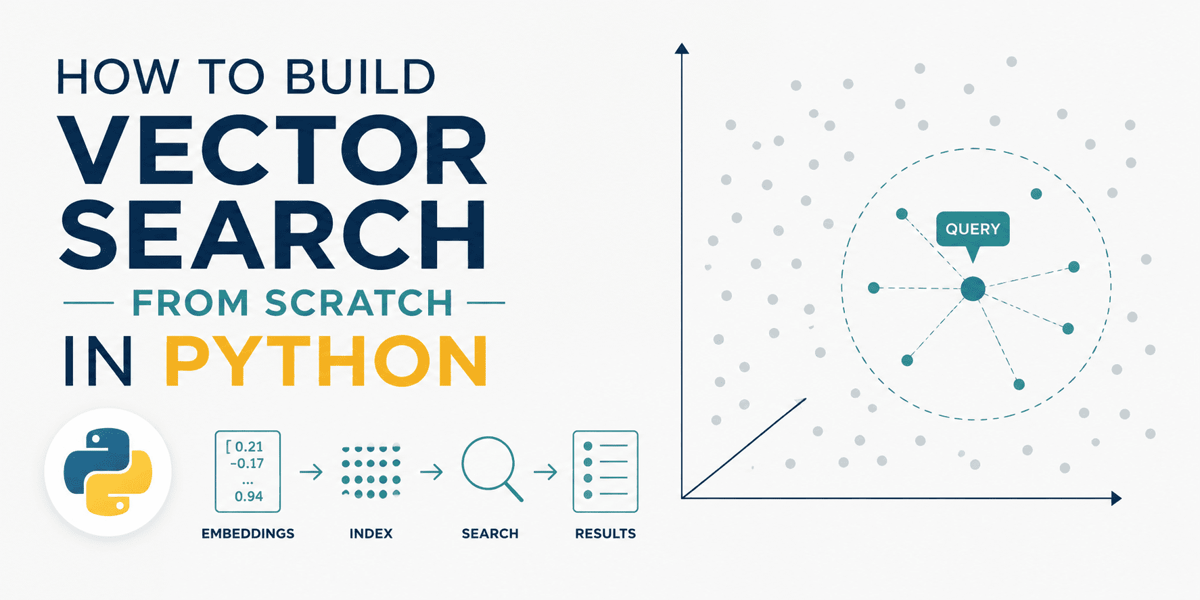
The tutorial demonstrates that a functional vector search engine can be built in under 50 lines of pure NumPy code. After seeding a synthetic catalog of 15 items, the embeddings are L2‑normalized, stored in a simple VectorIndex class, and queried with a dot‑product operation that yields cosine scores instantly. Visualizations using PCA confirm that semantically related items form distinct clusters, and score distributions reveal clear gaps that can guide threshold setting. The approach showcases how developers can prototype and benchmark semantic search without costly libraries or services.
For production, the same indexing logic scales to millions of vectors when paired with optimized libraries like FAISS or Annoy, while the embedding generation step can be upgraded to state‑of‑the‑art models such as sentence‑transformers or OpenAI embeddings. Integrating this pipeline enables e‑commerce sites, knowledge bases, and media platforms to surface contextually relevant results, reduce bounce rates, and increase conversion. As enterprises continue to digitize content, mastering vector search from the ground up becomes a strategic capability for data‑driven growth.
How to Build Vector Search From Scratch in Python
Comments
Want to join the conversation?