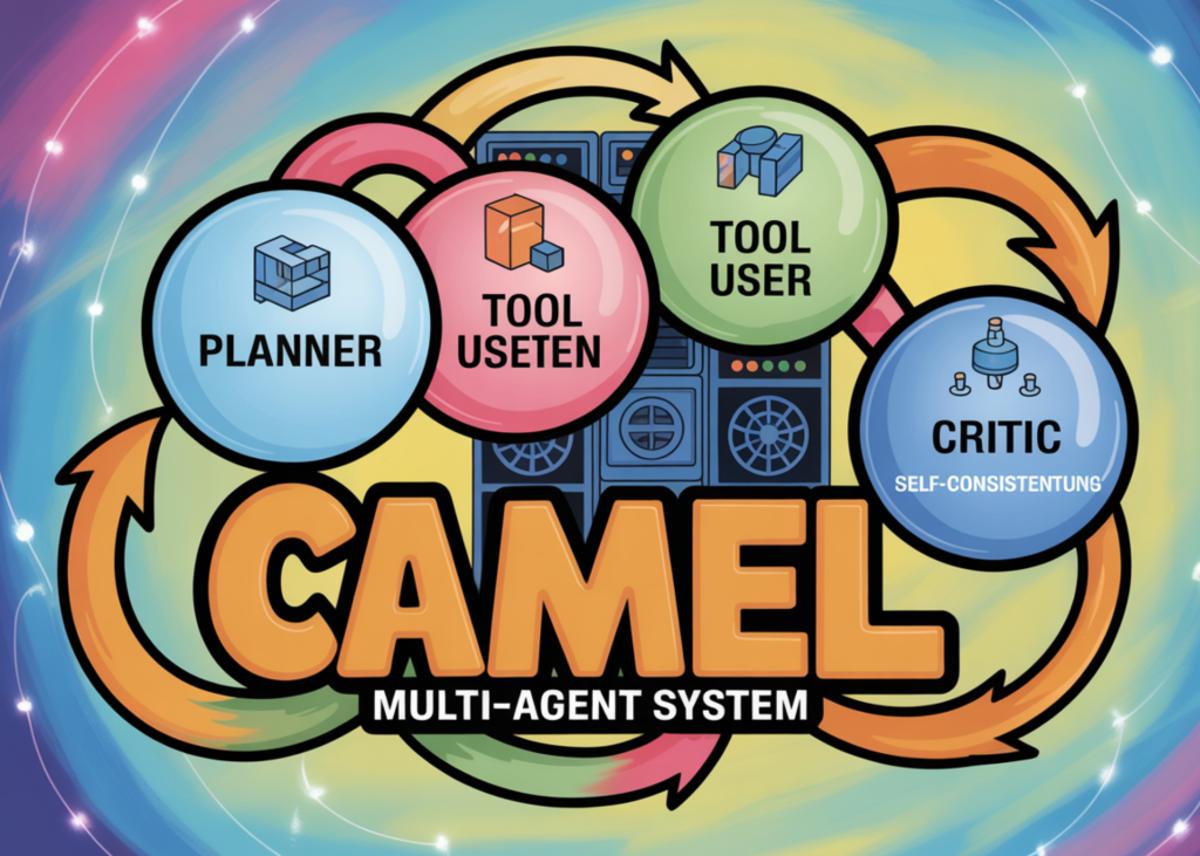
How to Design a Production-Grade CAMEL Multi-Agent System with Planning, Tool Use, Self-Consistency, and Critique-Driven Refinement

Companies Mentioned

Why It Matters
By demonstrating a rigorously validated, self‑correcting agent architecture, the guide shows how enterprises can move beyond ad‑hoc prompt chaining to reliable, production‑ready AI services.
Key Takeaways
- •CAMEL pipeline integrates planner, researcher, writer, critic, and rewriter agents
- •Structured Pydantic schemas enforce JSON output validation across agents
- •Self-consistency sampling generates multiple drafts for higher reliability
- •Critic agent scores drafts, guiding iterative revisions until quality threshold
- •Tool integration enables real-time web searches for evidence-backed content
Pulse Analysis
The rise of agentic AI has shifted focus from single‑prompt tricks to orchestrated workflows that can handle complex, multi‑step tasks. CAMEL, an open‑source framework, provides the scaffolding for such pipelines, allowing developers to define distinct roles for each agent and enforce strict data contracts with Pydantic. This separation of concerns not only improves code maintainability but also reduces the risk of hallucinations by ensuring every LLM response conforms to a predefined schema.
A key differentiator in the tutorial is the use of self‑consistency sampling, where the writer agent produces several candidate drafts. An auxiliary selector agent then picks the most coherent version, effectively applying ensemble reasoning to language generation. Coupled with a critic agent that scores drafts on relevance, correctness, and completeness, the system iteratively refines its output until it meets a predefined quality threshold. This loop mirrors human editorial processes and provides a measurable metric— a 0‑to‑10 score— for automated quality control.
From a business perspective, such a production‑grade pipeline offers tangible benefits: faster time‑to‑market for AI‑driven documentation, research briefs, or customer‑facing content; lower operational risk thanks to built‑in validation; and the ability to scale across domains by swapping out toolkits or models. As enterprises seek trustworthy AI solutions, frameworks like CAMEL that combine planning, tool use, self‑consistency, and critique‑driven refinement are poised to become foundational components of next‑generation intelligent systems.
How to Design a Production-Grade CAMEL Multi-Agent System with Planning, Tool Use, Self-Consistency, and Critique-Driven Refinement
Comments
Want to join the conversation?
Loading comments...