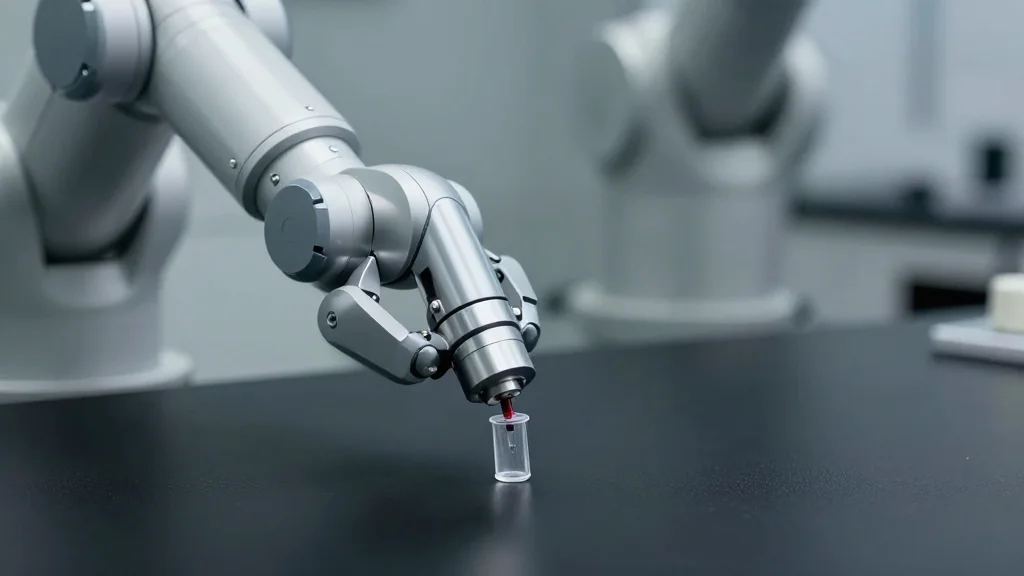
Hybrid AI Optimizes Robotic Arms for Precision Assembly
Why It Matters
By delivering faster, more accurate, and energy‑efficient robotic motions, the technology boosts productivity while lowering operational costs and carbon footprints across high‑precision manufacturing sectors.
Key Takeaways
- •Hybrid AI merges heuristics and neural nets for trajectory planning
- •Cuts assembly time while preserving micron‑level accuracy
- •Reduces motor energy use, extending robot lifespan
- •Provides transparent trade‑off insights for human operators
- •Scalable to complex, high‑DOF manufacturing tasks
Pulse Analysis
Precision assembly has long wrestled with the trilemma of speed, accuracy and energy use. Traditional deterministic planners often sacrifice one metric to improve another, leading to sub‑optimal throughput and higher wear on equipment. The new hybrid strategy sidesteps this by coupling evolutionary heuristics—such as genetic algorithms and particle‑swarm optimization—with neural‑network predictors trained on extensive simulation data. This blend enables rapid exploration of the high‑dimensional motion space while retaining the ability to forecast performance outcomes, delivering trajectories that meet tight tolerances without inflating cycle times.
Beyond raw efficiency, the framework addresses two emerging priorities for manufacturers: sustainability and operator trust. By optimizing motion paths to avoid unnecessary motor activations, the system cuts energy draw by up to 15%, directly translating into lower utility bills and a smaller carbon footprint—key metrics for companies pursuing ESG goals. Equally important, the built‑in interpretability layer surfaces the rationale behind each trajectory choice, allowing engineers to audit and adjust trade‑offs in real time. This transparency mitigates the black‑box stigma of AI, fostering smoother human‑robot collaboration on the shop floor.
Looking ahead, the researchers plan to integrate reinforcement learning that ingests live sensor feedback, enabling robots to refine their planning policies on the fly. Such continual learning could further shrink downtime and adapt to component variations without re‑training offline models. Cross‑disciplinary input from biomechanics, control theory and materials science is expected to accelerate these advances, positioning hybrid‑AI‑driven robots as a cornerstone of next‑generation manufacturing, aerospace assembly, and even surgical automation. Companies that adopt this technology early stand to gain a decisive competitive edge in speed, quality and sustainability.
Hybrid AI Optimizes Robotic Arms for Precision Assembly
Comments
Want to join the conversation?
Loading comments...