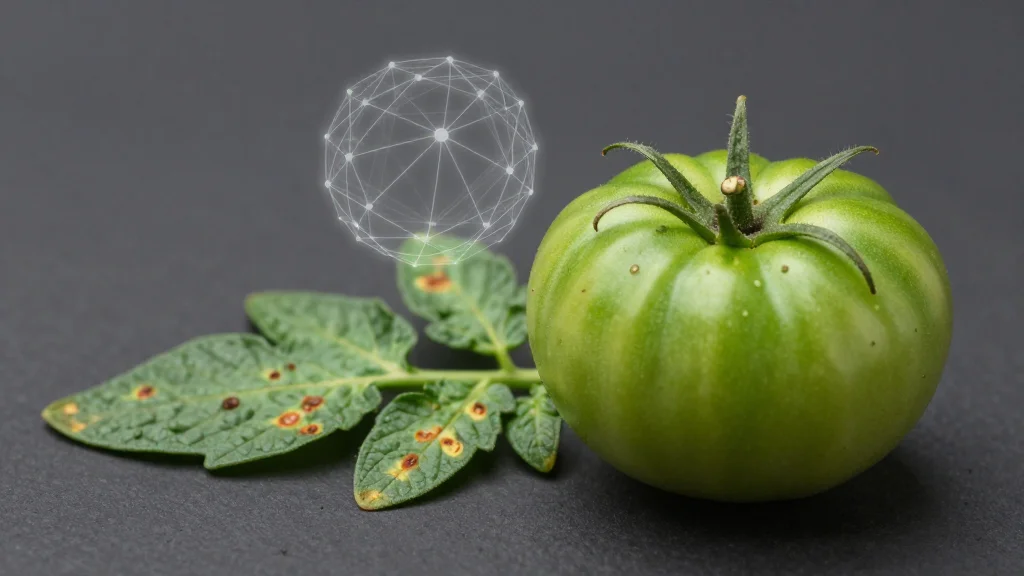
Hybrid Metaheuristics Boost Tomato Leaf Disease Detection
Why It Matters
Accurate, efficient disease detection lets farmers target interventions, cutting pesticide use and boosting yields, while the scalable AI framework can be adapted to other crops, driving broader adoption of digital agriculture.
Key Takeaways
- •Hybrid metaheuristics fine‑tune CNN hyperparameters automatically.
- •Model achieves higher accuracy and lower computational cost.
- •Validated on multiple tomato diseases with robust metrics.
- •Open‑source code and data enable reproducibility.
- •Supports precision agriculture, reducing chemical use and waste.
Pulse Analysis
The agricultural sector is rapidly embracing artificial intelligence to overcome age‑old challenges such as disease identification. Traditional scouting relies on expert eye‑balling, a time‑consuming process prone to human error, especially across large fields. Deep learning, particularly convolutional neural networks, offers a way to parse visual cues from leaf images, but the performance hinges on meticulous hyperparameter tuning—a task that often stalls deployment in resource‑constrained environments. By integrating AI with advanced optimization, researchers are bridging the gap between laboratory breakthroughs and real‑world farm applications.
Singh and colleagues introduced a hybrid metaheuristic suite that blends genetic algorithms, particle swarm optimization, and simulated annealing to explore the CNN design space. This multi‑objective strategy simultaneously maximizes classification accuracy, minimizes model size, and curtails inference time, making the solution viable on low‑power edge devices. Benchmarks on a diverse tomato leaf dataset showed measurable gains in precision, recall, and F1 scores compared with conventional training pipelines, and the open‑source release of code and data encourages reproducibility and rapid iteration across the research community.
The broader impact extends beyond tomatoes. A lightweight, high‑performing model can be mounted on drones or stationary cameras, delivering near‑real‑time disease alerts that enable targeted pesticide applications, lower chemical runoff, and higher crop yields. Such precision‑agriculture tools align with sustainability goals and present a compelling value proposition for agritech investors seeking scalable, data‑driven solutions. As IoT connectivity deepens on farms, the hybrid metaheuristic framework could be adapted to other crops, fostering a new generation of AI‑enabled decision support systems that safeguard food security while reducing environmental footprints.
Hybrid Metaheuristics Boost Tomato Leaf Disease Detection
Comments
Want to join the conversation?
Loading comments...