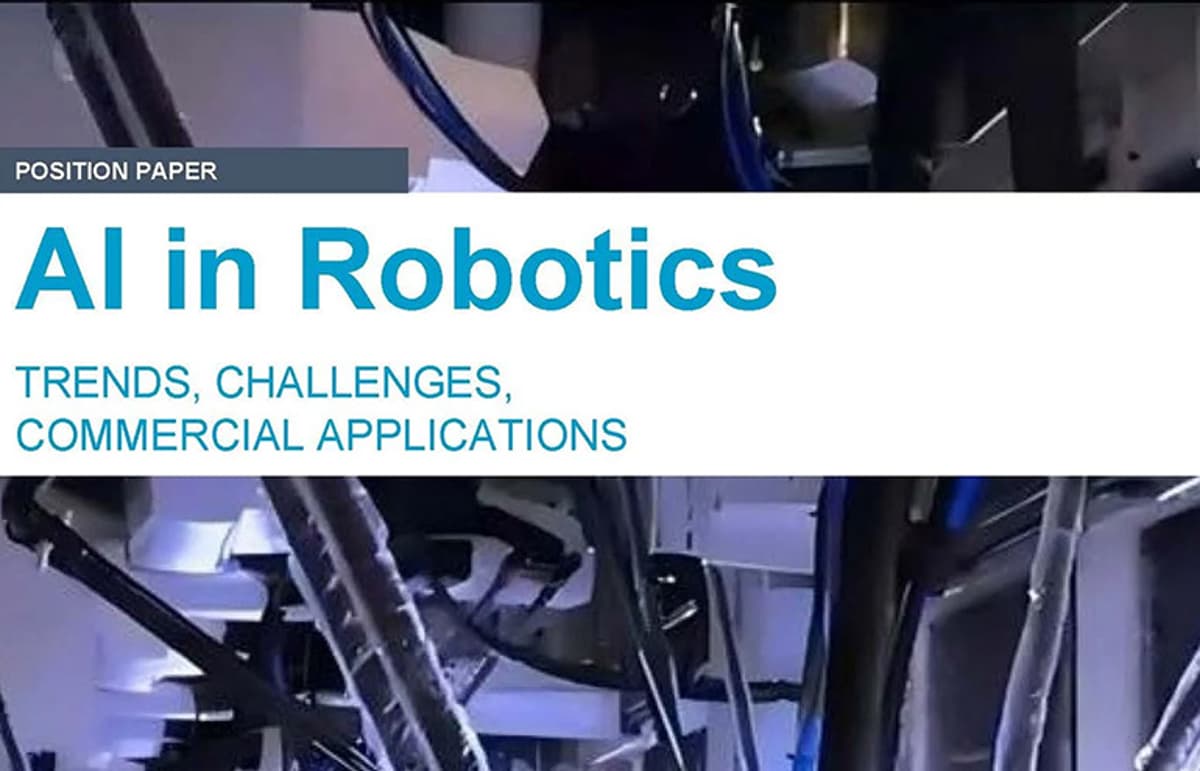
IFR Releases Position Paper on AI in Robotics
•February 17, 2026
0
Why It Matters
The analysis confirms a multi‑trillion‑dollar market trajectory and signals a fundamental shift in how manufacturers, logistics firms, and service providers will deploy intelligent automation.
Key Takeaways
- •AI boosts robot perception, navigation, and manipulation
- •Generative AI enables natural-language robot programming
- •US, Europe, China race with distinct AI‑robot strategies
- •AI adoption projected to cut errors, lower maintenance costs
- •New roles emerge: AI engineers, data scientists, ethicists
Pulse Analysis
The IFR’s new position paper arrives at a pivotal moment for the robotics sector, as analysts forecast a market worth several trillion dollars by 2030. By framing AI as a core enabler rather than a peripheral add‑on, the report underscores how machine‑learning models are being embedded directly into robot controllers, allowing devices to learn from simulated environments and real‑world feedback. This shift reduces the need for bespoke programming, accelerates time‑to‑value, and opens pathways for smaller firms to adopt sophisticated automation without prohibitive engineering costs.
Technical breakthroughs are at the heart of the paper’s optimism. Deep‑learning vision systems now deliver real‑time object recognition and defect detection on factory floors, while reinforcement learning refines motion planning through trial‑and‑error in virtual sandboxes. Perhaps most disruptive is generative AI, which can translate natural‑language commands into executable robot code, dramatically simplifying integration for non‑technical users. Coupled with multimodal sensor fusion for SLAM, these capabilities enable truly autonomous mobile robots in warehouses and manufacturing plants.
From a business perspective, the IFR highlights stark regional dynamics. U.S. giants such as Amazon, Tesla, and NVIDIA are pouring capital into AI‑robot startups, Europe sees strategic mergers like ABB’s divestiture to SoftBank, and China’s Ministry of Industry has launched a national action plan to embed embodied AI across key industries. The paper warns that while efficiency gains and reduced downtime are clear benefits, organizations must also address workforce transitions, data security, and sustainability standards to fully realize AI‑driven robotics’ potential.
IFR releases position paper on AI in robotics
0
Comments
Want to join the conversation?
Loading comments...