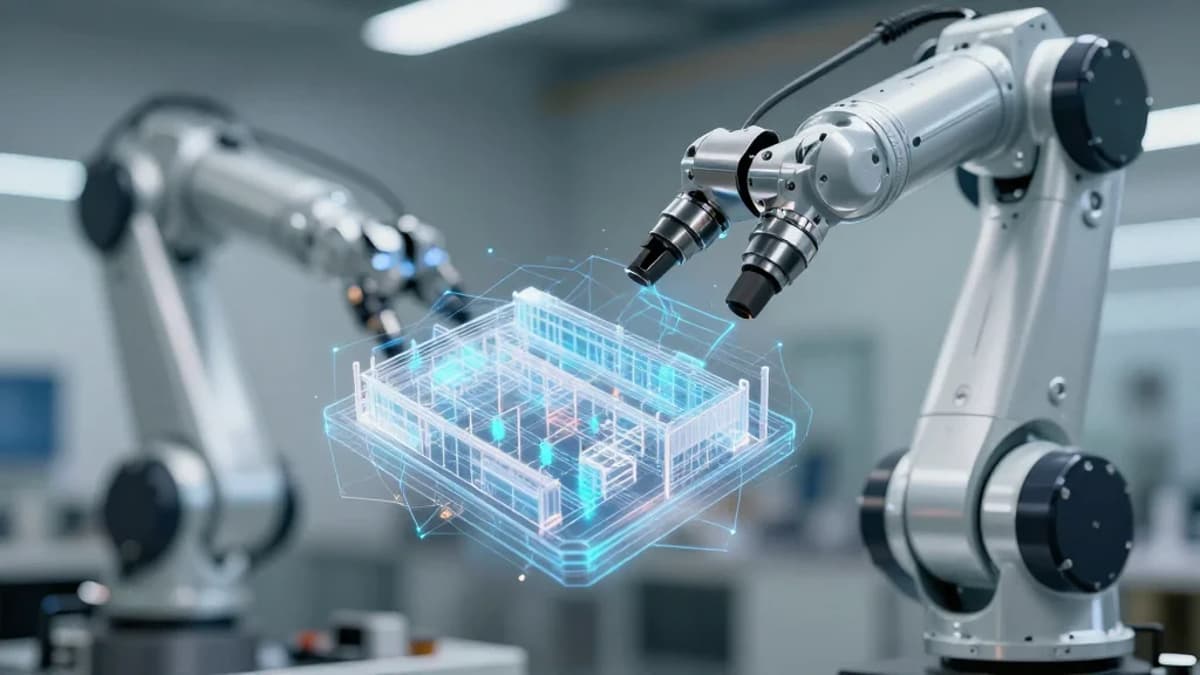
Industrial AI Platform Combines Virtual Twins, Accelerated Computing
•February 16, 2026
0
Companies Mentioned


Why It Matters
This partnership transforms industrial AI from a point tool into a mission‑critical system of record, enabling manufacturers to cut design‑test cycles dramatically while ensuring predictions obey physical laws and data‑sovereignty requirements.
Key Takeaways
- •100‑ to 1,000‑fold simulation speedup via NVIDIA acceleration
- •Physics‑validated virtual twins become real‑time AI companions
- •Sovereign cloud AI factories protect IP and data locality
- •ERP systems must integrate with real‑time twin data
- •Parallel virtual validation compresses development from months to weeks
Pulse Analysis
The convergence of Dassault Systèmes’ 3DEXPERIENCE virtual‑twin suite with NVIDIA’s AI hardware and software stack marks a watershed moment for industrial artificial intelligence. By embedding CUDA‑X libraries, Omniverse DSX Blueprint, and NVIDIA’s accelerated inference engines directly into the design environment, the partnership creates what the vendors call ‘Industry World Models’—dynamic, physics‑based representations that evolve with sensor feeds and simulation results. This approach moves AI beyond isolated generative tools, anchoring predictions in validated scientific models and enabling engineers to query complex material behavior or structural performance in real time.
The promised performance gains are staggering: early benchmarks cite 100‑ to 1,000‑fold reductions in simulation time, while the long‑term vision of AI factories envisions million‑fold acceleration as model libraries scale across continents. Such speed translates into parallel design‑test‑build loops, shrinking product development cycles from months to weeks and unlocking rapid iteration of thousands of design alternatives. Dassault’s OUTSCALE sovereign‑cloud offering further differentiates the solution by keeping proprietary geometry and process data within regional data centers, a critical requirement for aerospace, defense, and regulated manufacturing sectors.
For enterprise resource planning vendors and technology leaders, the shift signals a redefinition of the manufacturing system of record. Real‑time twin environments will feed continuous performance metrics into ERP, demanding bi‑directional APIs and robust data‑governance frameworks to protect intellectual property. Companies that adapt their ERP stacks to consume physics‑validated insights can offer predictive maintenance, dynamic scheduling, and cost optimization directly from the design phase. Conversely, firms that treat AI as a peripheral add‑on risk losing relevance as manufacturers gravitate toward integrated, cloud‑native AI factories that serve as the new backbone of industrial operations.
Industrial AI Platform Combines Virtual Twins, Accelerated Computing
0
Comments
Want to join the conversation?
Loading comments...