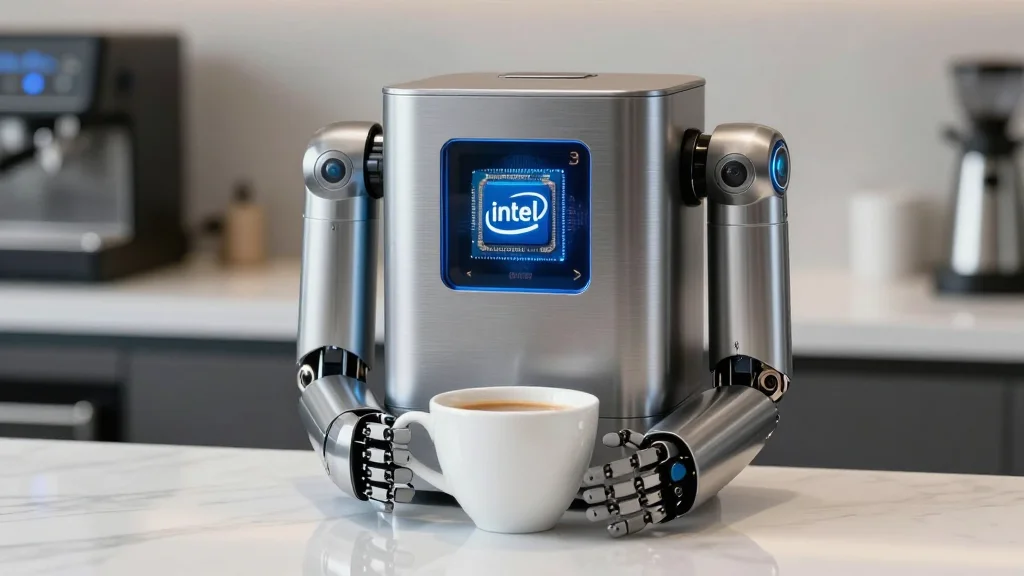
Intel Stakes New Claim in Physical AI with Robotics Chips
Companies Mentioned

Why It Matters
By delivering AI‑capable, power‑efficient chips for edge devices, Intel can capture a slice of the fast‑growing robotics sector and help manufacturers address labor shortages. The initiative also re‑establishes Intel as a key player in a market increasingly dominated by specialized AI hardware.
Key Takeaways
- •Intel's Core Ultra Series 3 chips now in 130 edge AI designs.
- •Single silicon integrates vision, control, and graphics for robotics.
- •Intel re‑enters robotics under CEO Lip‑Bu Tan, targeting edge AI.
- •Morgan Stanley projects $5 trillion robotics market by 2050.
- •Power‑efficient chips enable battery‑operated robots like barista Ella.
Pulse Analysis
Intel’s renewed focus on physical AI reflects a broader industry shift toward processing data at the edge rather than relying on cloud latency. The Core Ultra Series 3 line, originally built for laptops, has been re‑engineered to meet the stringent power‑budget of autonomous robots. By consolidating computer‑vision, real‑time control and graphics onto a single die, Intel reduces board‑level complexity and extends battery life, making it feasible to deploy mobile robots in retail, logistics and manufacturing without constant recharging.
From a technical standpoint, the Series 3 chips leverage Intel’s latest 10‑nanometer process, delivering higher transistor density and lower leakage than previous generations. This enables the integration of multiple AI inference engines on one package, allowing robots like SensoryAI’s Ella to run sophisticated world‑model algorithms locally. The result is faster response times for tasks such as order recognition or obstacle avoidance, and a more resilient system that can fall back to a “Guardian” agent when errors occur. The single‑chip approach also cuts BOM costs, a critical factor for scaling robot deployments across cost‑sensitive sectors.
The market opportunity is substantial. Morgan Stanley estimates a $5 trillion valuation for robotics by 2050, driven by labor shortages, safety concerns and the need for higher productivity. Intel’s entry re‑positions the company against rivals such as NVIDIA and Qualcomm, which have been courting edge‑AI customers for years. However, challenges remain: data scarcity for training robot‑specific models and the maturity of world‑model AI. Intel’s manufacturing expertise and its push for power‑efficient, integrated silicon could give it a competitive edge, provided it can accelerate the development of robust AI models that meet real‑world reliability standards.
Intel stakes new claim in physical AI with robotics chips
Comments
Want to join the conversation?
Loading comments...