Companies Mentioned

Why It Matters
SpatialAware turns Hue into a virtual lighting designer, boosting immersion and user control, which could set a new standard for smart‑home lighting experiences.
Key Takeaways
- •SpatialAware maps lights using phone AR
- •Remastered scenes adapt to fixture positions
- •Half of Hue scenes updated for SpatialAware
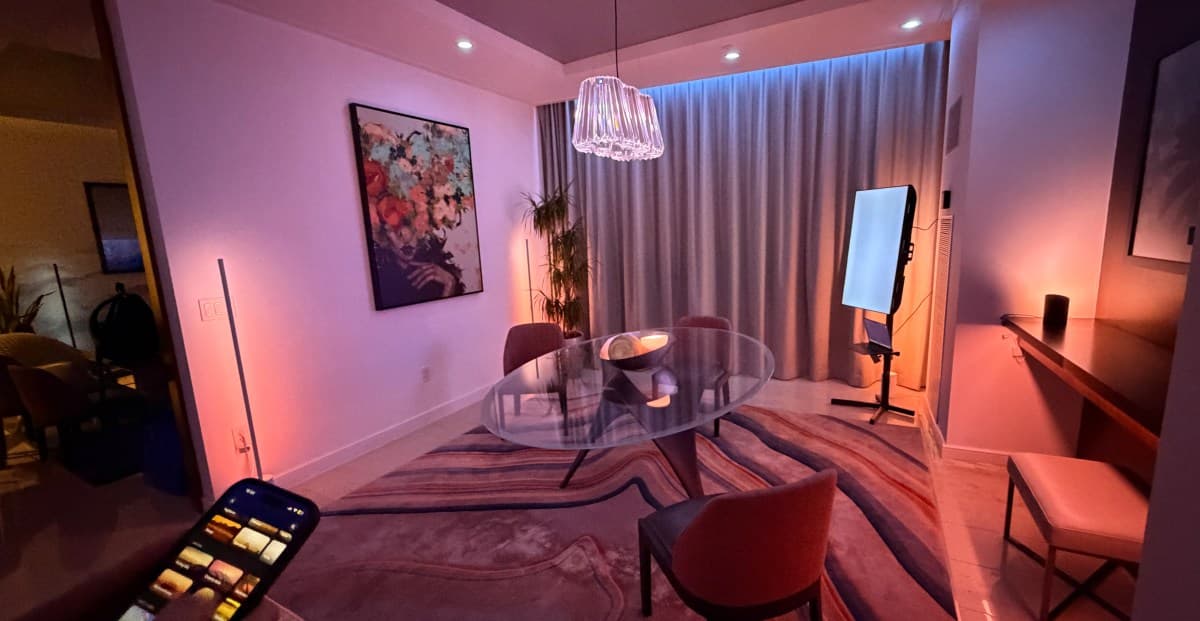
- •CES demo showed dramatic lighting improvement
- •Digital designer enhances immersive home lighting
Pulse Analysis
The launch of Hue’s SpatialAware marks a pivotal shift from generic color presets to context‑aware illumination. By harnessing a smartphone’s augmented‑reality sensors, the system builds a precise three‑dimensional map of a room, pinpointing each bulb’s location. This spatial intelligence allows the app to allocate hues and brightness levels based on actual fixture placement, creating gradients that mimic natural light sources such as sunsets or sunrise. For consumers, the result is a more cohesive ambience that feels tailored rather than artificially uniform.
From a market perspective, SpatialAware differentiates Philips Hue in an increasingly crowded smart‑lighting arena. Competitors have largely relied on static scenes or basic motion triggers, leaving a gap for dynamic, geometry‑aware lighting. By retrofitting roughly fifty percent of its existing scene library, Hue maximizes ROI on its content while offering developers a framework to craft future experiences that respond to room layout. This could accelerate adoption among interior designers and hospitality venues that demand nuanced lighting without manual programming.
The technology also signals broader trends in the IoT ecosystem, where sensor‑fusion and AI are converging to deliver context‑rich services. As AR capabilities become standard on smartphones, other smart‑home categories—such as climate control or audio—may adopt similar spatial mapping to fine‑tune performance. For investors and industry watchers, Hue’s SpatialAware serves as a case study in leveraging existing hardware (lights) with software upgrades to unlock new revenue streams and reinforce brand leadership in connected home innovation.
It turns out I’ve been using my Hue lights all wrong
0
Comments
Want to join the conversation?
Loading comments...