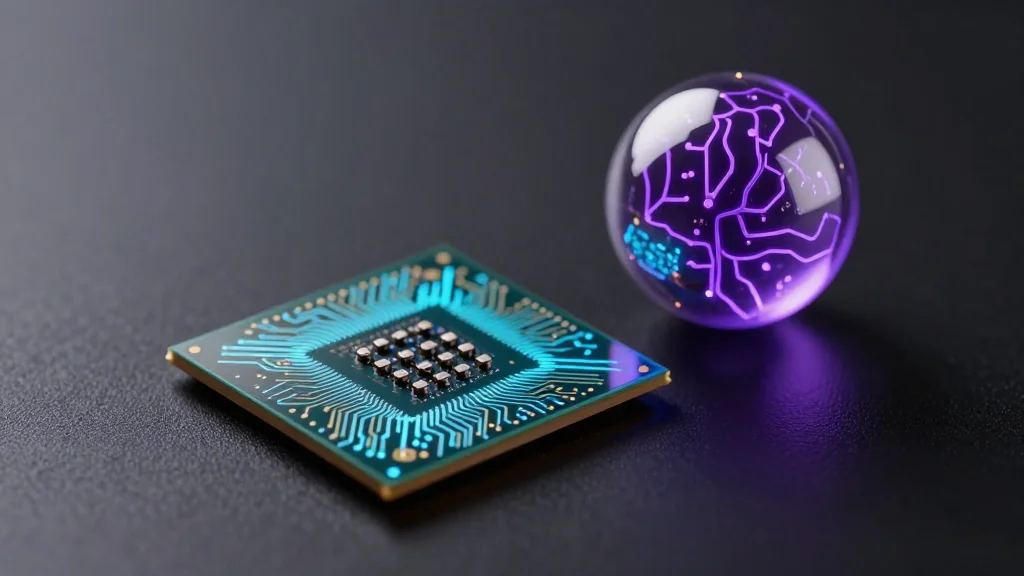
Leveraging Heterogeneous Computing Architecture to Power AI Solutions
Companies Mentioned
Why It Matters
The alliance accelerates enterprise AI adoption by providing a scalable, power‑efficient hardware foundation and a managed integration layer, helping organizations overcome talent, cost and governance barriers. It positions both firms as go‑to partners for the next wave of edge‑centric, agentic AI deployments.
Key Takeaways
- •Intel provides Xeon, GPU, AMX, SVS for heterogeneous AI workloads
- •Wipro integrates Intel hardware into edge-to-cloud AI solutions
- •Platform-based AI ops reduces complexity across CPU, GPU, FPGA, edge
- •Partnership tackles AI talent shortage and ROI justification for CIOs
- •Agentic AI projected to drive enterprise growth through 2026
Pulse Analysis
The AI wave has outgrown isolated pilots, demanding hardware that can handle diverse workloads from sensors to data‑center models. Intel’s heterogeneous computing stack—combining Xeon CPUs, discrete GPUs, AMX matrix extensions and Scalable Vector Search—delivers the performance density needed for real‑time inference at the edge while preserving cloud‑scale efficiency. By exposing a unified programming model, Intel enables developers to offload matrix‑intensive tasks to the most suitable engine, reducing latency and power consumption. This architectural flexibility is becoming a prerequisite for enterprises that want AI to run seamlessly across devices, edge nodes and central servers.
Wipro leverages that hardware foundation to build end‑to‑end AI services that span ML‑ops, AI‑ops and LLM‑ops, turning raw data into production‑grade models. The firm’s consulting expertise helps CIOs shift from project‑based experiments to platform‑based deployments, addressing common pain points such as talent scarcity, unclear ROI and fragmented security policies. By packaging Intel’s accelerators with managed services, Wipro offers a single pane of glass for monitoring, governance and scaling, allowing organizations to justify investment, accelerate time‑to‑value and mitigate the risk of model hallucinations.
Looking ahead, agentic AI—self‑directing systems that can orchestrate their own compute—will intensify demand for power‑efficient heterogeneous chips, especially as sustainability targets tighten. Intel and Wipro’s joint roadmap positions them to supply the requisite mix of CPU, GPU and specialized accelerators while providing the integration layer that enterprises need to adopt these models at scale. Companies that partner with a proven systems integrator are likely to capture the fastest growth in AI‑driven revenue, making the choice of technology partner a strategic differentiator in 2026 and beyond.
Leveraging heterogeneous computing architecture to power AI solutions
Comments
Want to join the conversation?
Loading comments...