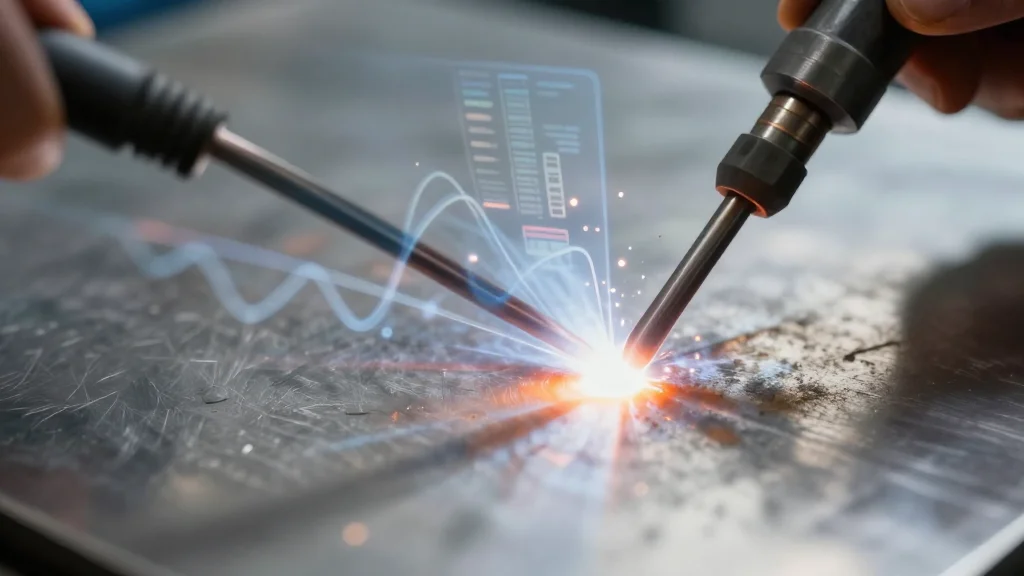
Machine Learning and Uncertainty Quantification for Predicting Weld Bead Geometry of AISI 304L in Micro-Size A-TIG Welding
Why It Matters
Accurate, uncertainty‑aware predictions enable more reliable A‑TIG process design, reducing trial‑and‑error costs and accelerating adoption of AI‑driven welding optimization.
Key Takeaways
- •XGBoost achieved 96% R² predicting weld bead geometry.
- •SiO₂ flux yielded highest depth‑to‑width ratio (0.794) at 160 A.
- •Ridge regression performed moderately, lagging behind XGBoost.
- •90% prediction intervals covered 56‑78% of observations.
- •Quantile regression highlighted under‑confident uncertainty estimates.
Pulse Analysis
Micro‑size Activated Tungsten Inert Gas (A‑TIG) welding promises finer control over weld bead geometry, yet the scarcity of experimental data has limited the deployment of data‑driven models. By systematically varying six activating fluxes—SiO₂, TiO₂, Al₂O₃, ZnO, CuO, and CaCO₃—researchers generated a compact 45‑run dataset that captures key geometric outputs: depth of penetration, bead width, and their ratio. This hybrid experimental‑computational framework provides a valuable benchmark for future studies seeking to balance laboratory effort with predictive power.
The study contrasted a linear Ridge regression baseline with the tree‑based Extreme Gradient Boosting (XGBoost) algorithm. While Ridge offered modest accuracy, XGBoost delivered a striking 96% R², underscoring the importance of capturing nonlinear interactions between flux chemistry, current settings, and weld pool dynamics. Among the fluxes, SiO₂ stood out, achieving a depth‑to‑width ratio of roughly 0.794 at 160 A, a result linked to flux‑induced arc constriction and Marangoni flow reversal that deepens penetration without widening the bead.
Beyond point predictions, the researchers applied quantile regression to quantify uncertainty, generating 90% prediction intervals. Empirical coverage ranged from 56% to 78% across the three geometry metrics, indicating that the intervals were informative yet under‑confident—especially for depth of penetration. This nuanced uncertainty insight equips welding engineers with risk‑aware guidance, allowing them to prioritize process parameters that balance performance and reliability. As AI integration deepens in manufacturing, such uncertainty‑aware models will be pivotal for scaling advanced welding techniques while minimizing costly trial runs.
Machine Learning and Uncertainty Quantification for Predicting Weld Bead Geometry of AISI 304L in Micro-Size A-TIG Welding
Comments
Want to join the conversation?
Loading comments...