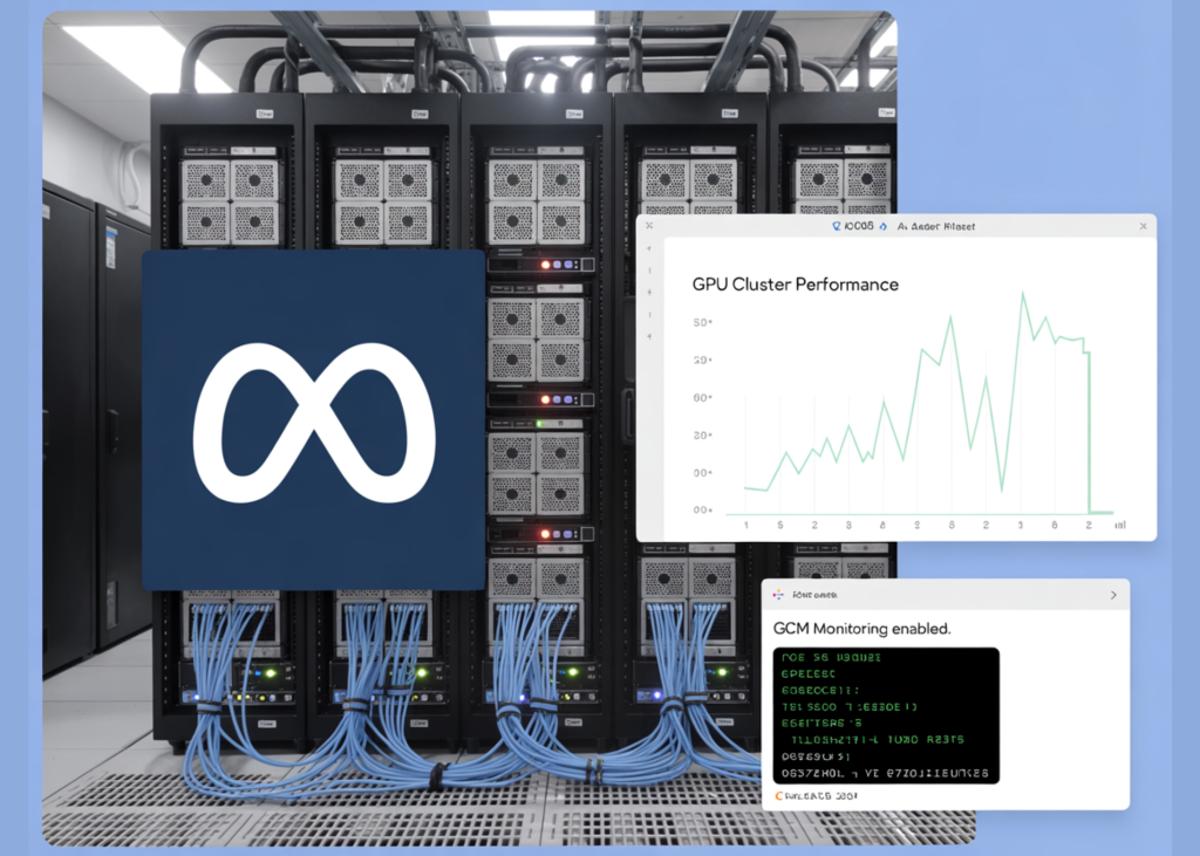
Meta AI Open Sources GCM for Better GPU Cluster Monitoring to Ensure High Performance AI Training and Hardware Reliability
•February 25, 2026
0
Why It Matters
By exposing hidden GPU degradations, GCM protects costly AI training runs and improves overall data‑center reliability, delivering measurable cost savings for enterprises and research labs.
Key Takeaways
- •GCM detects silent GPU failures in large clusters.
- •Direct Slurm integration maps metrics to job IDs.
- •Prolog/Epilog health checks prevent faulty node usage.
- •Telemetry exported via OpenTelemetry for modern observability.
- •Python core with Go modules ensures extensibility and performance.
Pulse Analysis
The race to train trillion‑parameter models has turned GPU farms into critical bottlenecks. While most organizations rely on generic cloud observability platforms, those tools often miss the subtle performance degradation that occurs when a single GPU silently throttles or develops an XID error. Such “zombie” GPUs can corrupt gradients, waste thousands of dollars in compute time, and delay research milestones. Meta’s AI Research team therefore released GCM, an open‑source monitoring stack built specifically for high‑performance computing environments where hardware stability is as important as software efficiency.
GCM bridges the gap between low‑level NVIDIA telemetry and cluster‑level orchestration. By hooking directly into Slurm, it attributes power, temperature, and error metrics to individual Job IDs, giving engineers instant visibility into which training run is affected. The framework runs pre‑job (Prolog) checks to verify InfiniBand health and GPU accessibility, and post‑job (Epilog) diagnostics via NVIDIA’s DCGM to confirm that no hardware damage occurred. All collected data is transformed into OpenTelemetry (OTLP) format, enabling seamless export to Prometheus, Grafana, or any modern observability stack.
The open‑source nature of GCM lowers the barrier for research labs and cloud providers to adopt rigorous hardware health checks without building custom solutions from scratch. Early adopters can expect reduced training interruptions, more accurate cost accounting, and higher overall model throughput. As AI workloads continue to dominate data‑center capacity, tools like GCM will become standard components of any HPC stack, prompting vendors to embed similar telemetry pipelines directly into their GPUs and schedulers. Meta’s contribution thus reinforces a broader industry shift toward observability‑driven AI infrastructure.
Meta AI Open Sources GCM for Better GPU Cluster Monitoring to Ensure High Performance AI Training and Hardware Reliability
0
Comments
Want to join the conversation?
Loading comments...