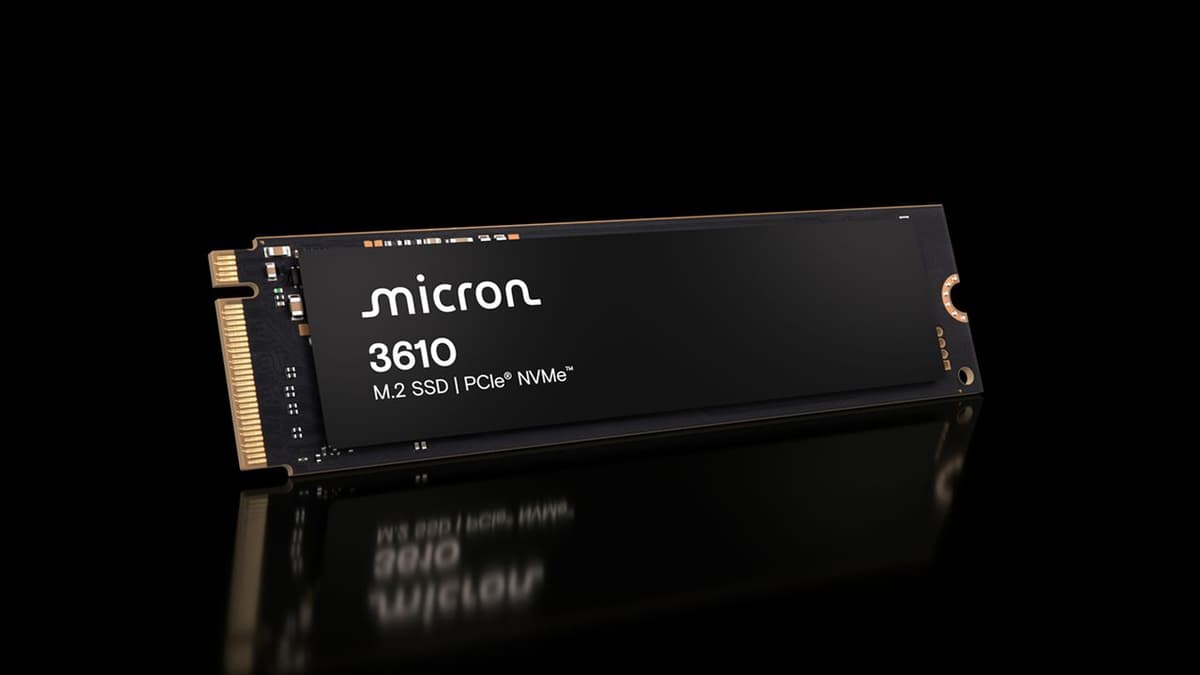
Micron Announces a QLC SSD Just Weeks After Killing Its Beloved Crucial Brand — the 3610 Is a Basic Gen5 SSD That's Somehow Faster than Gen4 TLC
•January 11, 2026
0
Companies Mentioned

Why It Matters
The 3610 brings Gen5 performance to cost‑sensitive QLC platforms, potentially reshaping the mainstream SSD market and accelerating on‑device AI adoption, while signaling Micron’s strategic pivot from the Crucial brand to enterprise‑focused growth.
Key Takeaways
- •First Gen5 G9 QLC SSD for consumer market
- •Single‑sided 2230 M.2 up to 4 TB capacity
- •Up to 11 000 MB/s sequential reads, 9 300 MB/s writes
- •Endurance doubles with capacity, up to 1 600 TBW
- •DRAM‑less design may affect sustained heavy workloads
Pulse Analysis
Micron’s 3610 launch arrives at a pivotal moment for solid‑state storage. By marrying PCIe Gen5 bandwidth with QLC NAND, the company challenges the long‑standing performance premium of TLC drives while keeping price points attractive for mainstream OEMs. The single‑sided M.2 2230 form factor also addresses the growing demand for ultra‑thin laptops, a segment that has traditionally sacrificed capacity for size. This move underscores Micron’s broader shift away from the consumer‑focused Crucial brand toward high‑growth enterprise and AI markets.
From a technical standpoint, the 3610’s advertised 11 GB/s sequential reads and up to 9.3 GB/s writes represent a 57 % and 45 % improvement over Gen4 QLC competitors. Random I/O performance scales with capacity, reaching 1.5 MIOPS reads on the 4 TB model, and latency figures of 50 µs read and 12 µs write rival many DRAM‑cached solutions. Benchmarks such as PCMark 10 and 3DMark show 30 % and 20 % gains respectively, while performance‑per‑watt improves up to 43 % versus Gen4 TLC drives, positioning the 3610 as an energy‑efficient option for AI inference and media‑intensive tasks.
The market implications are significant. If OEMs adopt the 3610 widely, it could compress the price‑performance gap between QLC and TLC, prompting rivals like Samsung and Western Digital to accelerate their own Gen5 QLC roadmaps. However, the DRAM‑less architecture may still hinder sustained throughput under heavy, continuous workloads, leaving a niche for higher‑end Gen5 TLC models. As on‑device AI workloads expand, the 3610’s blend of speed, capacity, and power efficiency could make it a compelling choice for next‑generation laptops and thin clients, while Micron leverages the product to reinforce its repositioning toward data‑centric, AI‑driven markets.
Micron announces a QLC SSD just weeks after killing its beloved Crucial brand — the 3610 is a basic Gen5 SSD that's somehow faster than Gen4 TLC
0
Comments
Want to join the conversation?
Loading comments...