Companies Mentioned

Why It Matters
The partnership demonstrates that high‑performance AI workloads can now run on compact, energy‑efficient edge devices, lowering barriers for SMBs and creators to adopt generative AI.
Key Takeaways
- •MS‑S1 MAX runs LLMs up to 109B locally.
- •Four‑node cluster cuts power 80% vs RTX 5090 server.
- •N5 Pro offers 80 TOPS AI and 144 TB hybrid storage.
- •Devices priced under $3k, targeting SMBs and creators.
- •AMD Ryzen AI processors enable edge AI across industries.
Pulse Analysis
The MINISFORUM‑AMD collaboration arrives at a pivotal moment for edge artificial intelligence, as enterprises scramble to move compute closer to data sources. By embedding AMD’s Ryzen™ AI Max+ and AI 9 HX PRO processors into ultra‑compact chassis, the duo delivers desktop‑class inference capabilities without the footprint or power draw of traditional 5U GPU servers. This shift reflects a broader industry trend toward decentralized AI, where latency‑sensitive applications—such as real‑time video analytics, on‑premise content generation, and secure data processing—benefit from localized compute.
Performance metrics underscore the strategic advantage: a four‑node MS‑S1 MAX cluster can run the DEEPSEEK 671B Q4 large language model while consuming just 0.72 kW, a stark contrast to the 4‑5 kW required by comparable RTX 5090 rigs. The resulting 77% cost reduction and 80% lower power usage make the solution attractive for small‑to‑medium businesses that lack data‑center budgets but still demand enterprise‑grade AI. Likewise, the N5 Pro’s 80 TOPS neural engine and 144 TB hybrid storage enable AI‑enhanced NAS functions—secure media libraries, intelligent photo tagging, and private LLM hosting—without sacrificing data privacy.
For AMD, the partnership expands its AI processor ecosystem beyond traditional PCs and servers into the burgeoning edge market. By aligning with MINISFORUM’s compact hardware expertise, AMD can showcase the versatility of its Ryzen AI line across diverse form factors, reinforcing its position against rivals like NVIDIA’s Jetson and Intel’s Xeon‑based edge solutions. As AI adoption accelerates across industries, the availability of affordable, low‑power devices that deliver comparable performance to bulkier systems could catalyze a wave of decentralized AI deployments, reshaping how organizations architect their compute infrastructure.
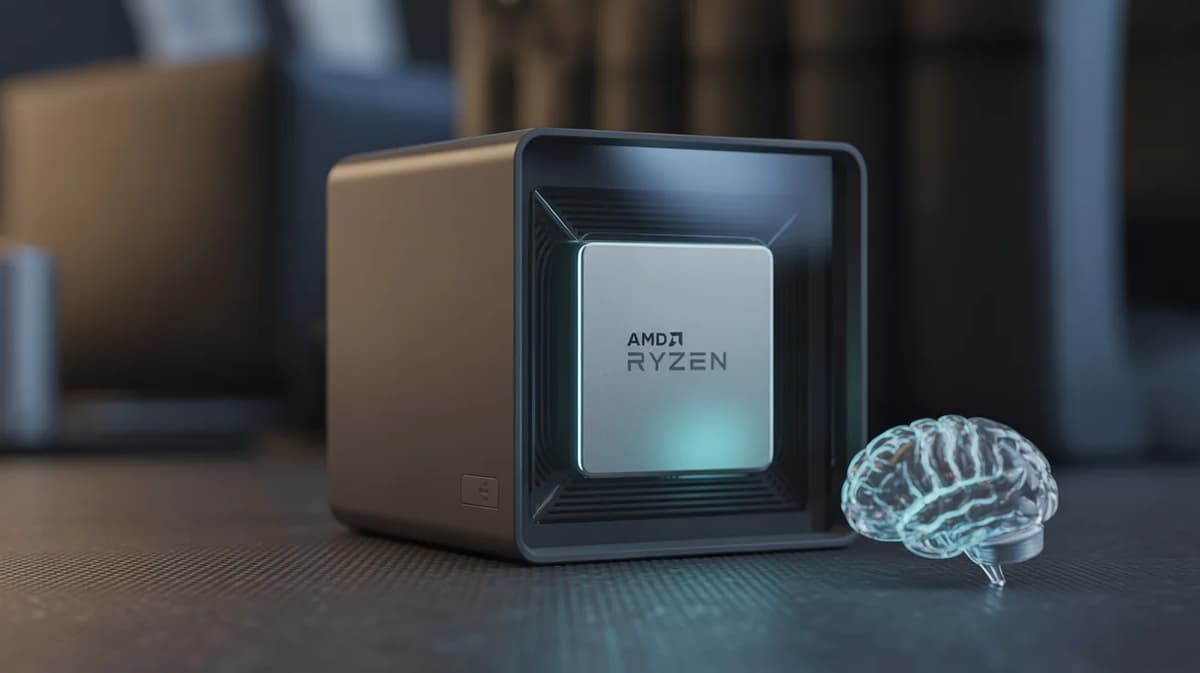
MINISFORUM and AMD Unite for AI-Powered Performance
0
Comments
Want to join the conversation?
Loading comments...