MIT Researchers Use AI to 'Speak' Objects Into Existence
•December 11, 2025
0
Why It Matters
The technology democratizes custom manufacturing, allowing non‑experts to produce on‑demand objects quickly and with minimal waste, potentially reshaping supply chains and prototyping workflows.
Key Takeaways
- •Speech-to-reality converts voice commands into tangible objects
- •Uses modular cubes for rapid, reusable assembly
- •AI ensures designs meet fabrication constraints automatically
- •Produces items in minutes, outpacing traditional 3D printing
- •Future upgrades target larger structures and gesture control
Pulse Analysis
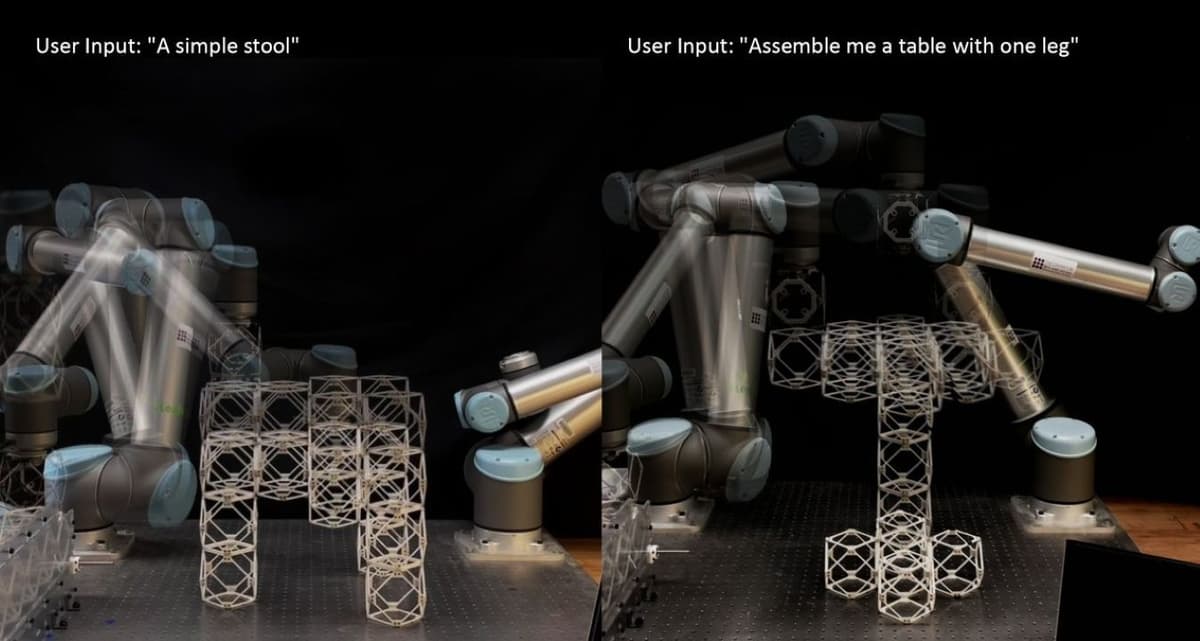
The MIT team’s speech‑to‑reality platform merges large language models, 3D generative AI, and robotic assembly. When a user speaks a simple description, the system creates a mesh, partitions it into stackable cubes, and directs a robotic arm to build the object. By embedding geometric reasoning and simulation, the pipeline automatically resolves overhangs, collision risks, and structural stability, turning abstract language into a manufacturable design. This tight coupling of natural‑language processing with physical constraints marks a departure from conventional CAD workflows that require expert modeling.
The breakthrough lowers the entry barrier for on‑demand fabrication. Non‑engineers can request custom furniture, decorative pieces, or functional components without learning CAD or programming, accelerating prototyping cycles for startups, designers, and education labs. Because the objects are assembled from reusable cubes, material waste is minimal compared with additive manufacturing, and production time shrinks to under five minutes—orders of magnitude faster than typical 3D printing. Such speed and sustainability could reshape supply‑chain models, enabling localized, small‑batch manufacturing and reducing inventory overhead.
Scaling the approach presents technical hurdles. Current magnetic connectors limit load‑bearing capacity, prompting research into stronger interlocks and mobile robotic platforms for larger assemblies. Integrating gesture‑based inputs could further streamline human‑robot interaction, creating multimodal interfaces that feel natural. If these challenges are solved, speech‑driven fabrication may become a staple in smart factories, retail kiosks, and even homes, driving a new wave of personalized manufacturing and expanding the market for modular robotic components.
MIT Researchers Use AI to 'Speak' Objects into Existence
0
Comments
Want to join the conversation?
Loading comments...