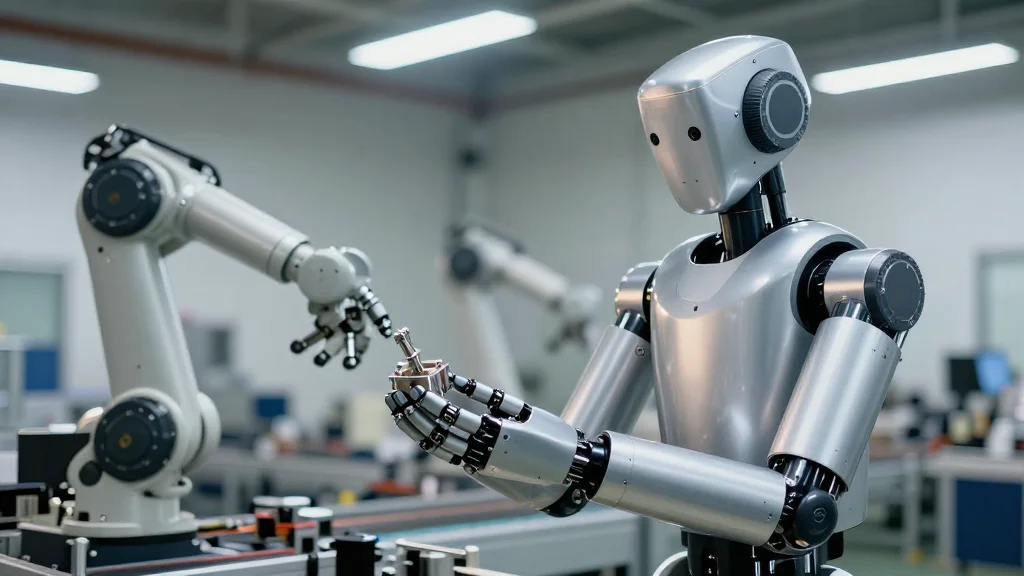
Mitsubishi Electric and Chiba Institute of Technology to Co-Research and Develop Homegrown Physical AI

Companies Mentioned
Why It Matters
The alliance tackles Japan’s acute labor shortage and aging infrastructure by accelerating AI‑driven automation, positioning both partners at the forefront of next‑generation robotics. Its success could reshape industrial productivity and set a benchmark for physical AI worldwide.
Key Takeaways
- •Three-year co‑creation center to commercialize humanoid, multi‑legged, drone robots
- •Focus on infrastructure inspection and industrial operations amid aging assets
- •Combines Mitsubishi’s automation expertise with Chiba’s motion‑technology research
- •Aims to address Japan’s labor shortage and geopolitical risk through AI robots
- •Physical AI could enable robots to match or exceed human adaptability
Pulse Analysis
Japan’s manufacturing sector faces a dual pressure of shrinking labor pools and increasingly complex, aging infrastructure. Mitsubishi Electric’s deal with the Chiba Institute of Technology represents a strategic response, leveraging physical AI to give robots the situational awareness traditionally reserved for skilled human operators. By establishing a dedicated co‑creation center, the partners aim to move beyond laboratory demos, delivering commercially viable systems that can navigate unpredictable environments, adjust tools in real time, and operate safely alongside humans.
The technical roadmap centers on three robot families: humanoid platforms for versatile tasks, multi‑legged machines capable of traversing uneven terrain, and autonomous drones for aerial inspections. Early deployments will target infrastructure monitoring—such as bridge and rail assessments—and factory floor automation, where precision and adaptability are critical. Mitsubishi contributes deep experience in factory automation and industrial control, while Chiba supplies cutting‑edge motion‑technology and large‑scale physical modeling. This synergy accelerates the translation of research breakthroughs into market‑ready solutions, shortening development cycles and reducing the cost barrier for end users.
Beyond immediate industrial gains, the partnership signals a broader shift toward AI‑enabled resilience. Physical AI could underpin logistics networks that self‑optimize routes, and emergency response robots that operate in disaster zones without direct human control. As global supply chains grapple with geopolitical volatility, Japan’s push for autonomous, adaptable robotics may set a new standard for resilient manufacturing and public‑safety applications, prompting competitors worldwide to invest in similar capabilities. The success of this venture could thus influence the next wave of automation across multiple sectors.
Mitsubishi Electric and Chiba Institute of Technology to Co-Research and Develop Homegrown Physical AI
Comments
Want to join the conversation?
Loading comments...