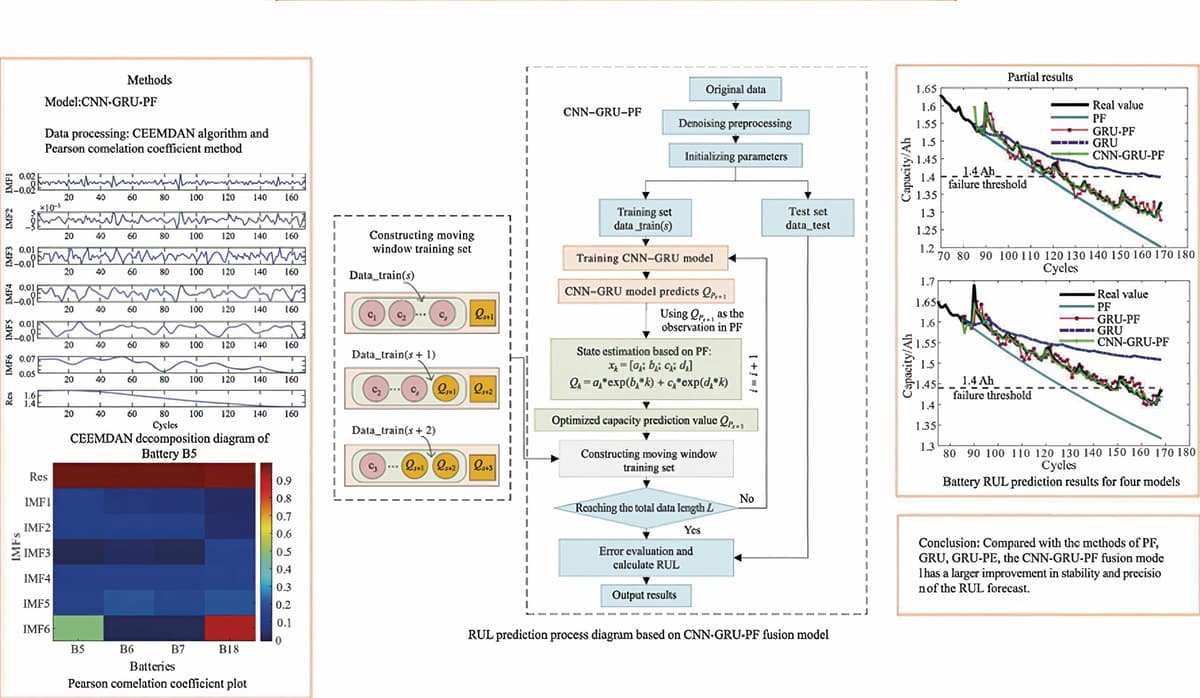
Model for Predicting Battery RUL
Why It Matters
The enhanced RUL forecasts enable EV manufacturers and fleet operators to optimize battery replacement schedules, reduce downtime, and improve safety. Superior prediction accuracy also lowers total cost of ownership by preventing unexpected failures.
Key Takeaways
- •CNN‑GRU‑PF hybrid improves RUL prediction accuracy up to 87% vs GRU alone
- •Uses CEEMDAN denoising and Pearson correlation to preprocess capacity data
- •Particle filter refines CNN‑GRU outputs, enhancing stability with limited samples
- •Tested on NASA battery datasets, showing consistent gains across multiple cells
- •Moving‑window training loop enables dynamic model adaptation over time
Pulse Analysis
Accurate remaining‑useful‑life (RUL) estimation is a cornerstone of modern electric‑vehicle (EV) battery management. Traditional physics‑based models offer interpretability but require deep domain knowledge and struggle with the nonlinear degradation patterns seen in high‑energy cells. Pure data‑driven techniques such as convolutional neural networks (CNNs) and gated recurrent units (GRUs) can capture complex patterns when abundant data exist, yet they often suffer from error accumulation over long horizons and are vulnerable to noisy or sparse datasets. Hybrid approaches that blend physical insight with machine learning are emerging as a pragmatic solution, aiming to balance accuracy, robustness, and computational efficiency.
The Chang’an University team’s CNN‑GRU‑PF fusion model tackles these challenges through a multi‑stage pipeline. First, capacity measurements undergo complete ensemble empirical mode decomposition with adaptive noise (CEEMDAN) and Pearson correlation analysis, effectively denoising the signal while preserving degradation trends. A 1‑D CNN then extracts high‑dimensional spatial features, and a GRU models temporal dependencies to generate initial forecasts. These forecasts serve as observations for a particle filter, which corrects deviations and stabilizes predictions. A moving‑window strategy recycles particle‑filtered outputs back into the CNN‑GRU, enabling continual learning and superior long‑term performance even when training data are limited.
Industry implications are significant. By delivering up to 87% improvement over standalone GRU models, the hybrid system can extend vehicle range confidence, reduce unexpected battery failures, and streamline maintenance planning for fleets and OEMs. The methodology also offers a template for other degradation‑prone assets, such as grid‑scale storage or aerospace power systems. As EV adoption accelerates, scalable, accurate RUL tools like this will become essential for managing total cost of ownership and meeting safety standards, prompting further investment in hybrid AI‑physics frameworks across the mobility sector.
Model for predicting battery RUL
Comments
Want to join the conversation?
Loading comments...