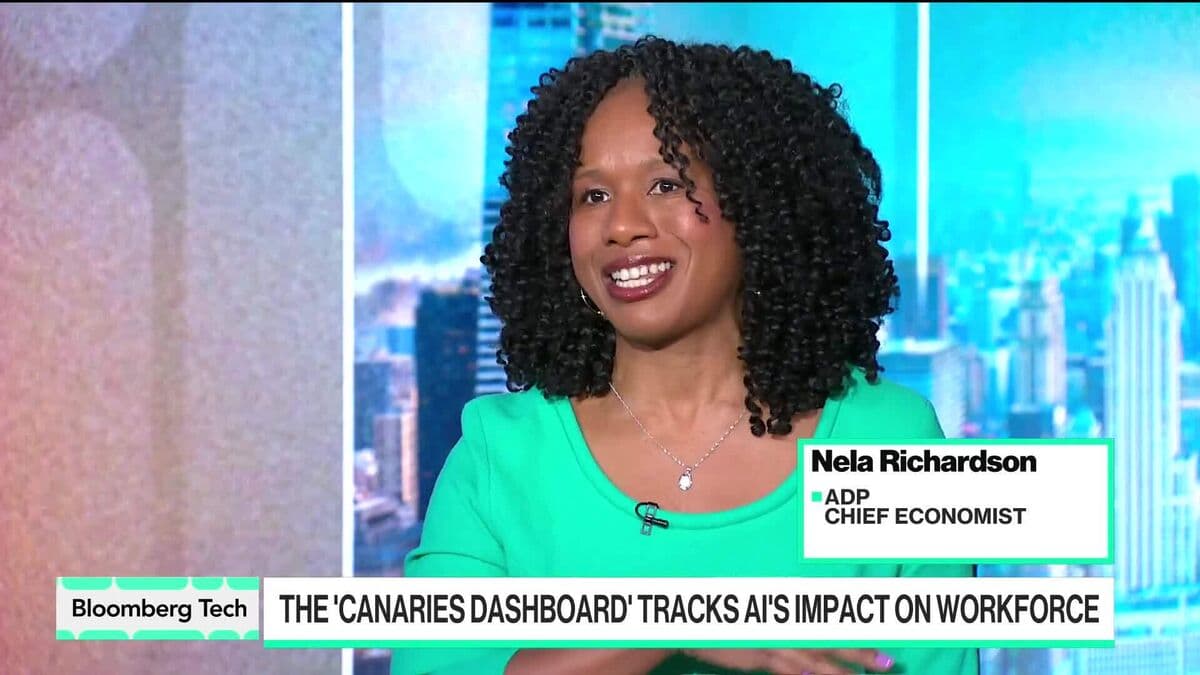
New Tracker Traces AI’s Real-Time Impact on Work

Why It Matters
The data gives employers and policymakers concrete evidence of AI’s uneven labor impact, informing strategies to mitigate early‑career job losses and leverage augmentation opportunities.
Key Takeaways
- •ADP and Stanford launch Canaries dashboard tracking AI impact in real time
- •Dashboard categorizes 700 occupations by AI exposure using payroll data
- •Early‑career software developers in AI‑exposed roles fell 20% since Nov 2022
- •Older workers see growth, highlighting automation versus augmentation divide
- •Employers can use data to shift AI from automation to higher‑value tasks
Pulse Analysis
The rapid diffusion of generative AI has outpaced traditional metrics, leaving businesses grasping for reliable signals of how the technology reshapes work. ADP’s new Canaries dashboard, built with Stanford’s Digital Economy Lab, fills that gap by pulling anonymized payroll data to assess AI exposure across more than 700 occupations. By updating the index weekly, the platform offers a near‑real‑time pulse on labor market dynamics, allowing analysts to move from speculative headlines to data‑driven narratives about AI’s economic footprint.
Early‑career workers are feeling the brunt of automation, with the dashboard showing a 20% decline in software developers aged 22‑25 since ChatGPT’s debut. In contrast, older professionals in the same fields are experiencing modest hiring growth, underscoring a bifurcation where routine coding tasks are automated while complex problem‑solving remains human‑centric. The tool also spotlights sectors like radiology, where AI augments diagnostic precision, shifting clinicians toward patient interaction rather than pattern recognition. These granular insights reveal where AI acts as a labor substitute versus a productivity enhancer.
For corporate decision‑makers, the Canaries data translates into actionable strategy. Companies can identify AI‑exposed functions early, re‑skill talent, and target augmentation opportunities that drive profit synergies—potentially adding ten percentage points to margins on day one, as cited by IBM’s leadership. By grounding AI adoption in empirical labor trends, firms can balance efficiency gains with workforce stability, positioning themselves to capture value while mitigating displacement risks.
New Tracker Traces AI’s Real-Time Impact on Work
Comments
Want to join the conversation?
Loading comments...