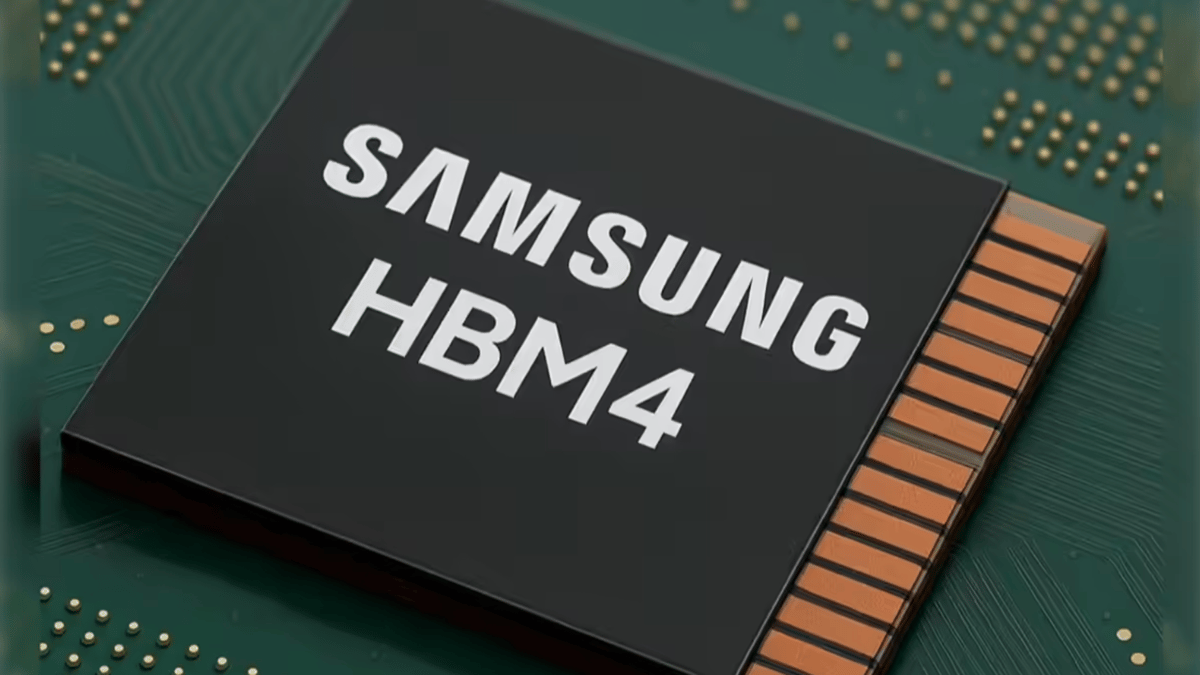
Now That's a Team-Up: Samsung and Nvidia Expected to Join Forces to Feature 'Revolutionary' HBM4 Memory Modules in Upcoming Vera Rubin Hardware
•January 28, 2026
0
Companies Mentioned


Why It Matters
Coordinated HBM4 delivery reduces AI infrastructure lead times and strengthens Samsung’s foothold in the high‑bandwidth memory market, while giving Nvidia a performance edge for next‑gen workloads.
Key Takeaways
- •Samsung's HBM4 ships February 2026 for Nvidia Rubin
- •HBM4 runs 11.7 Gb/s, boosting AI bandwidth
- •Joint production sync cuts scheduling risk
- •Memory, storage, accelerators co‑optimized for end‑to‑end performance
- •Early GTC demos showcase HBM4‑enabled Rubin
Pulse Analysis
High‑bandwidth memory has become the bottleneck for scaling AI models, and Samsung’s HBM4 marks a significant leap in that arena. Operating at 11.7 Gb/s and fabricated on a 4 nm logic base, the new modules deliver roughly 30% more bandwidth than the preceding generation. This performance boost enables larger model parameters and faster training cycles, positioning Samsung as a key supplier for the most demanding AI workloads. The move also reflects the broader industry shift toward integrating memory, compute, and storage to minimize data‑movement latency.
Nvidia’s Vera Rubin platform, designed for massive parallelism, benefits from Samsung’s synchronized production timeline. By aligning HBM4 shipments with Rubin accelerator manufacturing, both companies mitigate the scheduling uncertainties that have plagued earlier AI supply chains. This joint approach contrasts with competitors that rely on third‑party foundries, where delays can ripple through the entire hardware stack. The partnership also extends to AMD, where Samsung has completed verification, but Rubin will be the first to see mass‑market HBM4 deployment, giving Nvidia a competitive advantage in early‑adopter performance benchmarks.
The market implications are substantial. As AI workloads proliferate across cloud, enterprise, and edge environments, demand for memory‑centric solutions is accelerating. Samsung’s early‑stage HBM4 adoption signals confidence in its manufacturing capacity and may pressure rivals like SK Hynix to expedite their own roadmaps. For customers, the integrated Rubin‑HBM4 solution promises reduced total cost of ownership by shortening time‑to‑value and simplifying logistics. Looking ahead, the success of this collaboration could set a template for tighter memory‑compute co‑design, shaping the next wave of AI hardware innovations.
Now that's a team-up: Samsung and Nvidia expected to join forces to feature 'revolutionary' HBM4 memory modules in upcoming Vera Rubin hardware
0
Comments
Want to join the conversation?
Loading comments...