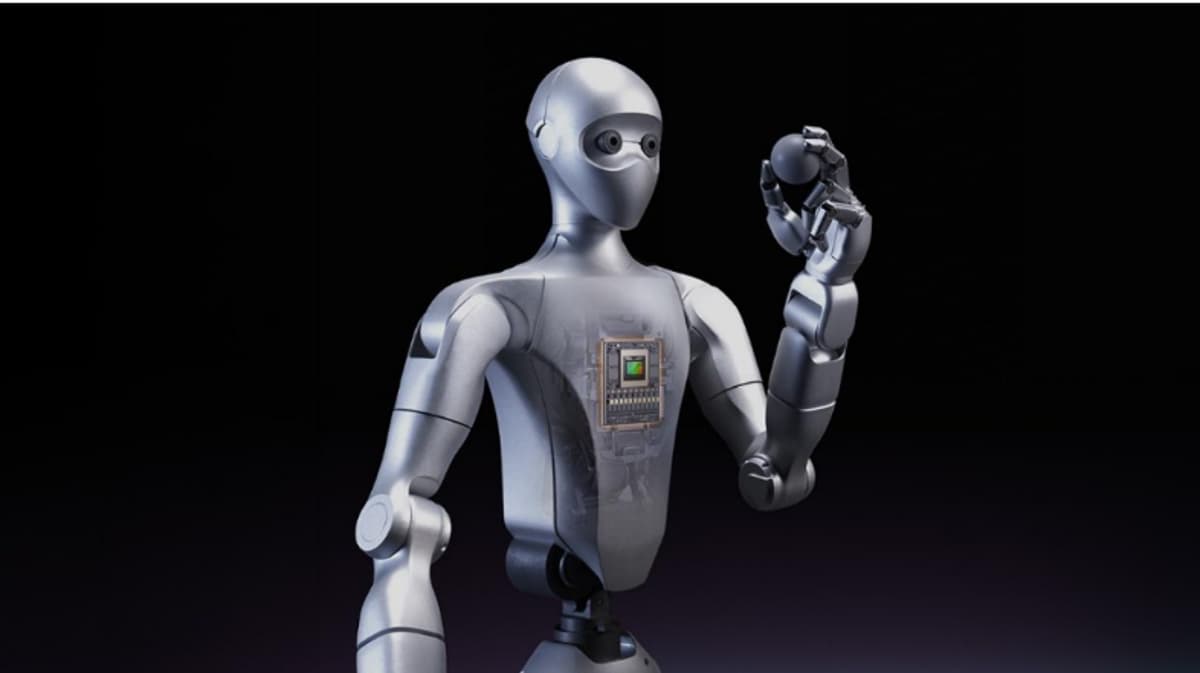
Nvidia and Unitree Release H2 Plus Reference Design for Humanoid Robots
Companies Mentioned

Why It Matters
By marrying high‑end AI compute with a dexterous, human‑scale body, H2 Plus lowers the barrier for real‑world humanoid research, accelerating the path to commercial physical‑AI solutions in logistics, manufacturing and beyond.
Key Takeaways
- •H2 Plus combines Unitree chassis with Nvidia Jetson AGX Thor compute.
- •2,070 FP4 teraflops AI performance enables real‑time robot inference.
- •31 body DOF + 22 hand DOF = 75 total degrees.
- •Stanford, ETH Zurich, AI2 among first institutions to use H2 Plus.
Pulse Analysis
The launch of Nvidia’s Isaac GR00T‑powered H2 Plus marks a pivotal moment for physical‑AI development. Humanoid robots have long suffered from fragmented toolchains that force engineers to stitch together disparate hardware, simulation environments, and data pipelines. By delivering a single reference design that bundles a human‑scale body, dexterous tactile hands, and a Blackwell‑based Jetson compute module, Nvidia and Unitree provide a turnkey platform that can be deployed from lab benches to factory floors with minimal integration effort.
Technically, H2 Plus packs a formidable suite of capabilities: a 6‑foot, 150‑pound frame with 31 degrees of freedom in the torso and limbs, plus dual five‑finger hands adding 22 more axes for a total of 75 degrees of freedom. Its onboard Jetson AGX Thor T5000 offers 2,070 FP4 teraflops of AI throughput, 128 GB of unified memory, and a configurable 40‑130 W power envelope, enabling on‑robot inference for perception, control and manipulation. Integrated sensors—including stereo and wrist cameras, IMU, and a 15 Ah battery for roughly three hours of operation—feed the Isaac software stack, which spans Isaac Sim, Isaac Lab, Teleop data capture, and accelerated ROS middleware, allowing researchers to train policies in simulation and transfer them seamlessly to the physical robot.
The ecosystem impact is immediate. Prestigious institutions such as Stanford Robotics Center, ETH Zurich, and the Allen Institute for AI have committed to using H2 Plus, signaling broad academic endorsement. This adoption accelerates open‑science collaboration, reduces duplication of infrastructure, and shortens the time from algorithmic breakthrough to real‑world validation. As the platform becomes publicly available on GitHub and Hugging Face, a wider community of developers can contribute models and tools, potentially unlocking multitrillion‑dollar opportunities in logistics, warehousing, and other labor‑intensive sectors. H2 Plus thus serves as both a research catalyst and a commercial springboard for the next generation of humanoid robots.
Nvidia and Unitree release H2 Plus reference design for humanoid robots
Comments
Want to join the conversation?
Loading comments...