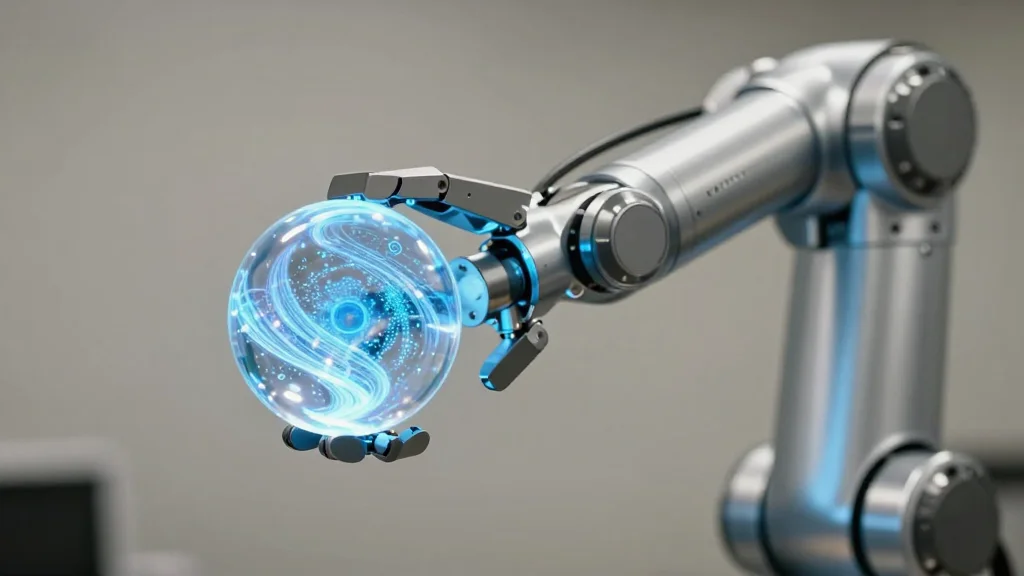
NVIDIA Corporation (NVDA) Turns to AI-Powered Robots to Power Industrial Revolution
Companies Mentioned
Why It Matters
NVIDIA’s robot‑focused models could accelerate AI adoption in heavy‑industry sectors, creating new revenue streams beyond traditional data‑center sales. The move also intensifies competition in the burgeoning industrial‑robot market, where synthetic data and language‑driven control are becoming differentiators.
Key Takeaways
- •Isaac GR00T enables robots to follow natural language commands
- •Cosmos generates synthetic data for large‑scale robot training
- •NVIDIA leverages GPU expertise to power AI robot workloads
- •Robot AI market expected to grow beyond $100 billion by 2030
- •Investors watch NVIDIA's robot push amid broader AI hype
Pulse Analysis
NVIDIA’s recent GTC showcase signals a strategic shift from pure data‑center dominance to the physical realm of robotics. By releasing Isaac GR00T, an open model that interprets natural‑language instructions, the company aims to lower the barrier for developers to build versatile robots that can handle complex, multistep tasks. Paired with Cosmos, a synthetic‑data generation platform, NVIDIA provides the training horsepower required to scale robot intelligence without the prohibitive costs of real‑world data collection. This combination leverages the firm’s deep GPU expertise, positioning its hardware as the de‑facto engine for robot AI workloads.
The industrial‑robot market is poised for rapid expansion, driven by labor shortages, onshoring trends, and the need for precision in sectors such as agriculture, manufacturing, and energy. Synthetic data, a core offering of Cosmos, addresses a critical bottleneck: acquiring diverse, high‑quality training sets for varied environments. Competitors like Boston Dynamics and ABB rely on proprietary data pipelines, whereas NVIDIA’s open‑source approach could foster a broader ecosystem of third‑party developers, accelerating innovation and adoption. Analysts project the global robot‑AI market to exceed $100 billion by 2030, underscoring the commercial upside of early platform leadership.
From an investment perspective, NVIDIA’s robot push diversifies its revenue base beyond the already booming AI‑inference and training segments. However, the venture also introduces execution risk, as success depends on ecosystem uptake and the ability to monetize software services tied to robot deployments. While the company’s GPU moat remains strong, investors should weigh the potential upside against the heightened competition from specialized robotics firms and emerging AI chipmakers. Overall, NVIDIA’s integration of language models and synthetic data into robotics reinforces its position as a foundational AI infrastructure provider, but market participants will watch closely to see how quickly these tools translate into tangible sales.
NVIDIA Corporation (NVDA) Turns to AI-Powered Robots to Power Industrial Revolution
Comments
Want to join the conversation?
Loading comments...