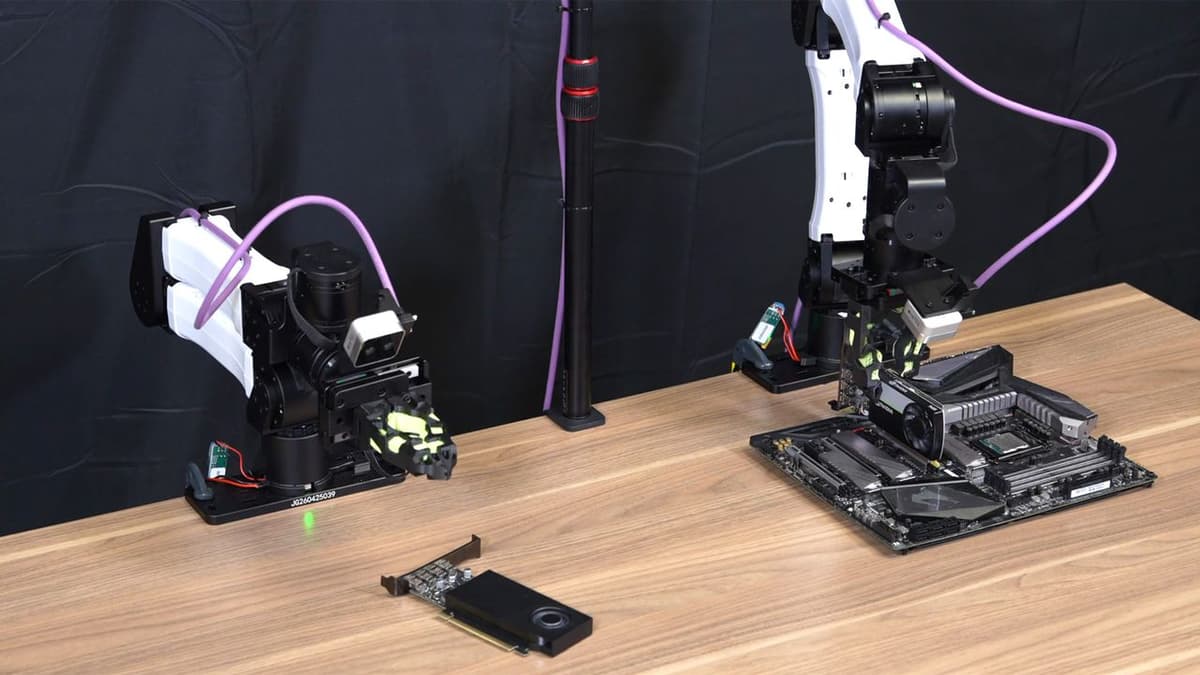
Nvidia Reveals AI Robots that Taught Themselves to Install GPUs Into Motherboards — Video Shows Robot ‘Solve High-Precision Tasks Like… Installing GPUs All by Itself’
Companies Mentioned
Why It Matters
The breakthrough demonstrates that autonomous AI can handle complex hardware assembly, opening pathways for self‑optimizing manufacturing and data‑center maintenance. It signals a shift toward physical AutoResearch, reducing labor costs and accelerating innovation cycles.
Key Takeaways
- •Nvidia's ENPIRE robots self‑learn GPU installation without human coding
- •Eight Codex agents coordinated a fleet of robots, accelerating task completion
- •ENPIRE framework combines environment reset, policy improvement, rollout, evolution modules
- •Scaling to multiple robots proved faster than single‑robot approaches
- •Demo highlights potential for autonomous physical AI research in data centers
Pulse Analysis
Nvidia’s ENPIRE project marks a pivotal moment in the convergence of artificial intelligence and robotics, showcasing that large‑language‑model‑driven agents can extend their reasoning from code to tangible hardware. By granting Codex agents an API that manipulates real‑world actuators, the system bridges the gap between simulated environments and physical assembly lines, a capability that has long eluded the industry. This leap is especially relevant for sectors like semiconductor manufacturing and data‑center construction, where precision and repeatability are paramount.
The technical backbone of ENPIRE consists of four modular components: an Environment module that automatically resets and verifies the setup, a Policy Improvement module that refines robot actions, a Rollout module that evaluates policies across multiple robots in parallel, and an Evolution module that analyzes logs and updates training code. In comparative tests, Codex paired with GPT‑5.5 outperformed Claude Code and Kimi Code, and the eight‑robot fleet completed the GPU‑installation task significantly faster than smaller groups, illustrating the power of parallel autonomous learning.
Industry implications are profound. Autonomous robots that can self‑teach complex assembly steps could automate routine maintenance in data centers, reduce reliance on skilled technicians, and accelerate product rollouts. Moreover, the ENPIRE framework offers a template for broader AutoResearch applications, where AI agents iteratively improve physical processes without constant human oversight. As the technology matures, businesses can expect lower operational costs, higher throughput, and a new competitive edge driven by AI‑enabled hardware autonomy.
Nvidia reveals AI robots that taught themselves to install GPUs into motherboards — video shows robot ‘solve high-precision tasks like… installing GPUs all by itself’
Comments
Want to join the conversation?
Loading comments...