Nvidia Wants to Create Universal AI Agents for All Worlds with NitroGen
•December 21, 2025
0
Companies Mentioned

Why It Matters
Universal AI agents like NitroGen can dramatically reduce game‑specific development costs and accelerate AI research across interactive media, reshaping how developers create and test game mechanics.
Key Takeaways
- •NitroGen trained on 40k gameplay hours from 1k+ games
- •Extracts player inputs via controller overlay detection
- •Outperforms scratch models by up to 52% success rate
- •Works across diverse genres and physics engines
- •Dataset, weights, paper, and code released publicly
Pulse Analysis
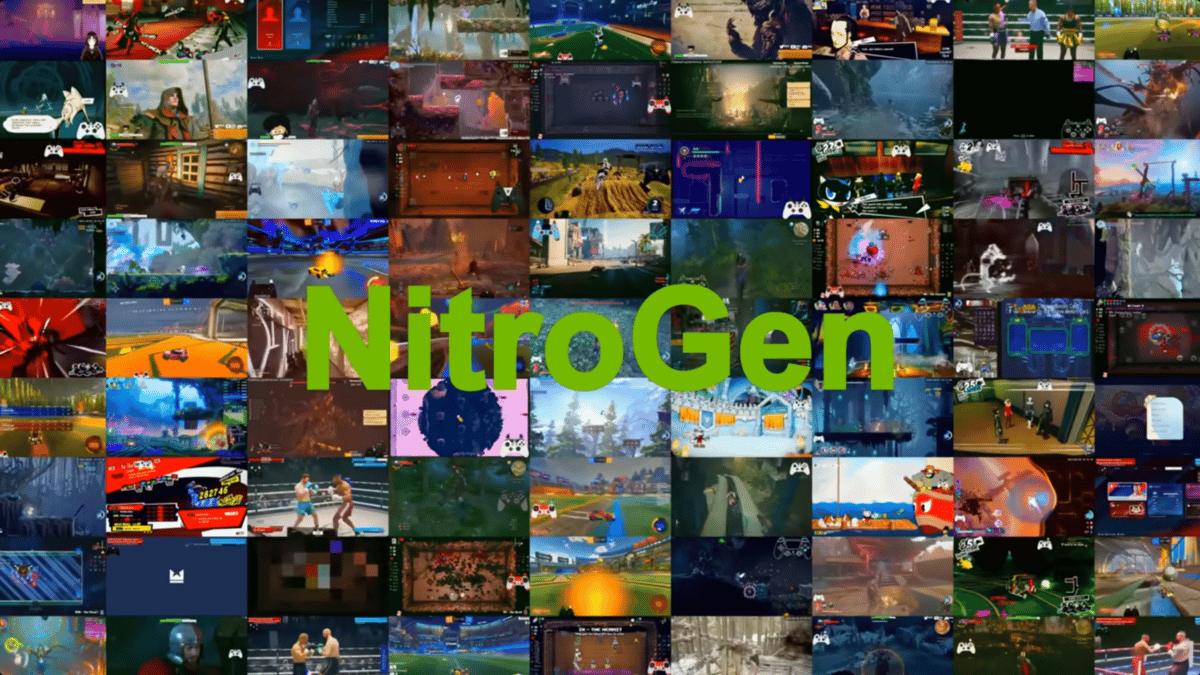
Nvidia's NitroGen marks a significant leap in the convergence of robotics foundation models and interactive entertainment. By harvesting 40,000 hours of publicly available gameplay streams, the research team sidestepped traditional data collection bottlenecks, leveraging controller overlay detection to translate human actions into training signals. This methodology not only expands the scale of available data but also introduces a reproducible pipeline for future AI agents across any visual medium, from console titles to virtual reality environments.
The model’s architecture builds on the GR00T N1.5 robotics framework, extending its physical‑world reasoning to virtual physics engines with varying dynamics and visual styles. NitroGen’s ability to generalize across genres—action RPGs, platformers, roguelikes—demonstrates that a single foundation model can adapt to disparate game mechanics without retraining from scratch. In benchmark tests, it achieved up to a 52 percent improvement in task success rates, highlighting the efficiency gains possible when a universal agent is deployed in unfamiliar settings.
Open‑sourcing the dataset, model weights, and code amplifies NitroGen’s impact beyond Nvidia’s own labs. Researchers and developers can now experiment with cross‑game AI, accelerate prototyping of non‑player characters, and explore novel automation use‑cases such as automated playtesting or personalized gaming experiences. As the industry grapples with rising development costs, NitroGen offers a scalable, cost‑effective pathway to embed sophisticated AI behavior across the gaming ecosystem, potentially setting a new standard for AI‑driven interactivity.
Nvidia wants to create universal AI agents for all worlds with NitroGen
0
Comments
Want to join the conversation?
Loading comments...