Companies Mentioned

Why It Matters
Embedding Codex in Chrome lowers the barrier for developers and non‑technical users to leverage AI coding, accelerating adoption across the broader software ecosystem. It also positions OpenAI to compete more aggressively in the AI‑augmented development tools market.
Key Takeaways
- •Chrome extension adds web‑app testing, multi‑tab context, DevTools integration
- •Works on Windows and macOS, expanding Codex’s cross‑platform reach
- •Aims to merge Codex, ChatGPT, and Atlas into a unified super‑app
- •Could attract casual users and non‑developer professions to AI coding tools
Pulse Analysis
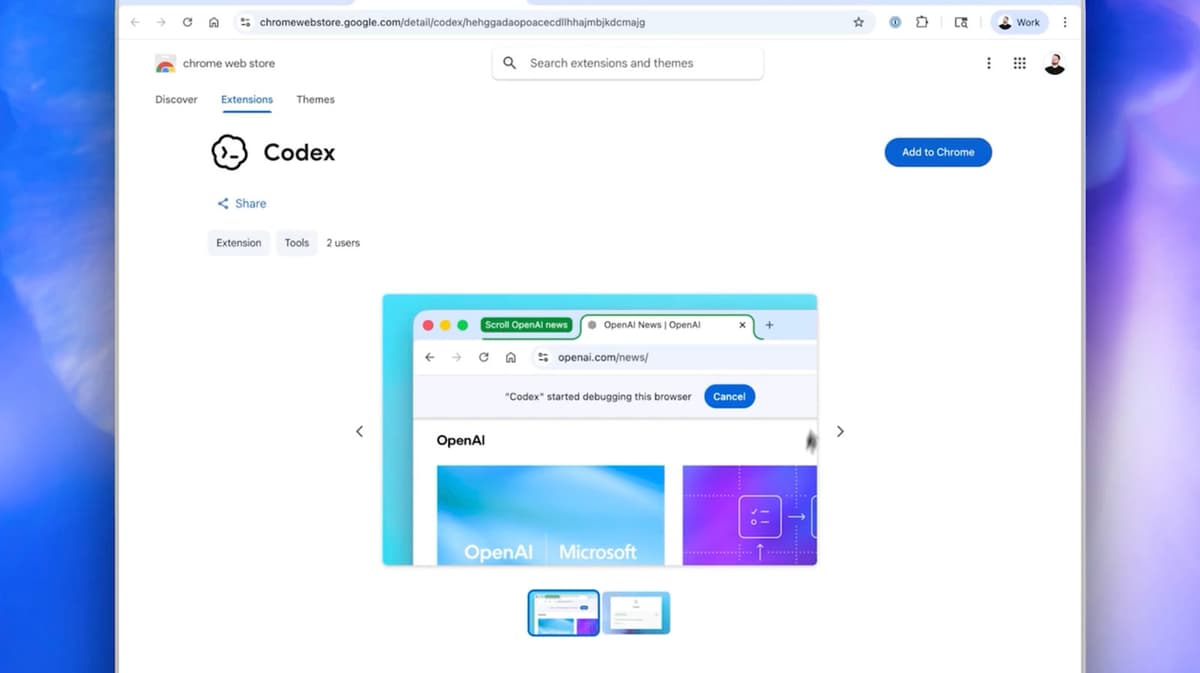
OpenAI’s new Chrome extension brings its Codex AI coding engine into the everyday browser environment, a shift that could redefine how developers and power users interact with code. By allowing real‑time testing of web applications, harvesting context from multiple tabs, and integrating with Chrome DevTools, the plugin transforms the browser into a lightweight IDE. This capability removes the need for heavyweight local setups, making AI‑driven code suggestions instantly accessible during routine browsing tasks.
Strategically, the extension broadens Codex’s reach beyond the macOS‑only app launched earlier this year, tapping into the massive Windows user base and reinforcing OpenAI’s cross‑platform ambitions. The move also dovetails with the company’s roadmap to fuse Codex, ChatGPT, and the Atlas browser into a single super‑app, a consolidation that could streamline user workflows and create a compelling alternative to traditional development stacks. Competitors in the AI‑assisted coding space will need to match this level of integration to stay relevant.
For the market, the Chrome plugin lowers the entry threshold for non‑technical professionals who perform routine computing tasks in browsers, such as data analysts, marketers, and product managers. By offering AI‑generated code snippets and debugging assistance without leaving the web, OpenAI positions Codex as a universal productivity enhancer. As adoption grows, the data harvested from diverse user interactions will likely refine Codex’s models, creating a feedback loop that accelerates both capability and market penetration.
OpenAI debuts a Codex plugin for Chrome
Comments
Want to join the conversation?
Loading comments...