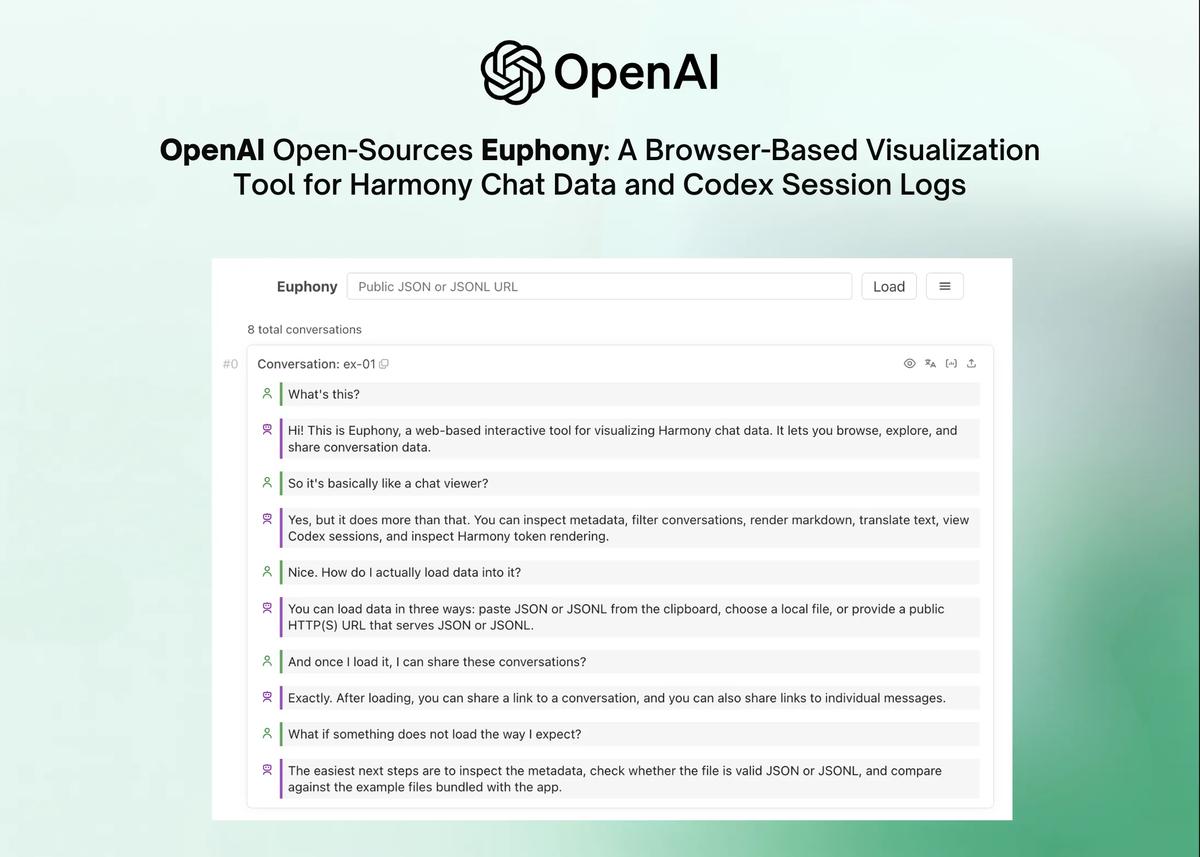
OpenAI Open-Sources Euphony: A Browser-Based Visualization Tool for Harmony Chat Data and Codex Session Logs

Why It Matters
By turning opaque JSON logs into readable visual flows, Euphony speeds up development, debugging, and dataset curation for AI agents, lowering the barrier for teams to build and iterate on complex multi‑modal systems.
Key Takeaways
- •OpenAI releases Euphony, visualizing Harmony and Codex logs in-browser
- •Supports auto-detection of four data structures, including raw JSON fallback
- •Features JMESPath filtering, focus mode, grid view, and in-browser editor
- •Offers frontend-only deployment and optional FastAPI backend for large datasets
- •Provides embeddable Web Components for React, Vue, Svelte, under Apache 2.0
Pulse Analysis
Debugging modern AI agents often feels like untangling a knot of nested JSON, where each step—file reads, API calls, code generation, and self‑revision—leaves developers sifting through thousands of tokens without a clear stack trace. Traditional log viewers provide raw data but lack the contextual hierarchy needed to understand an agent’s reasoning flow. Euphony addresses this gap by converting Harmony‑formatted conversations and Codex session logs into a timeline view that surfaces role‑based messages, tool calls, and metadata in a single, navigable interface, dramatically reducing the time spent reconstructing execution paths.
Beyond basic rendering, Euphony packs advanced features that cater to large‑scale dataset work. Its JMESPath query engine lets users filter conversations on any JSON attribute, while focus mode isolates messages by role or content type, enabling rapid skimming of massive logs. The grid view offers a spreadsheet‑like overview, and an in‑browser editor permits on‑the‑fly corrections without leaving the UI. Developers can choose a pure frontend deployment for static hosting or enable a FastAPI backend to handle remote file loading and heavy‑weight transformations, though OpenAI warns against exposing the backend publicly due to SSRF risks. The library’s Web Component architecture means teams can embed the visualizer directly into existing dashboards, regardless of framework, and fully style it via CSS custom properties.
Euphony’s release signals a broader push toward tooling that demystifies the inner workings of autonomous AI systems. By open‑sourcing a flexible, embeddable visual debugger, OpenAI empowers startups and enterprises to accelerate agent development cycles, improve dataset quality, and lower operational costs. The Apache 2.0 license encourages community contributions, potentially spawning plugins for other model formats and fostering an ecosystem of interoperable AI observability tools. As multi‑step agents become central to products ranging from code assistants to autonomous agents, tools like Euphony will be essential for maintaining reliability and trust.
OpenAI Open-Sources Euphony: A Browser-Based Visualization Tool for Harmony Chat Data and Codex Session Logs
Comments
Want to join the conversation?
Loading comments...