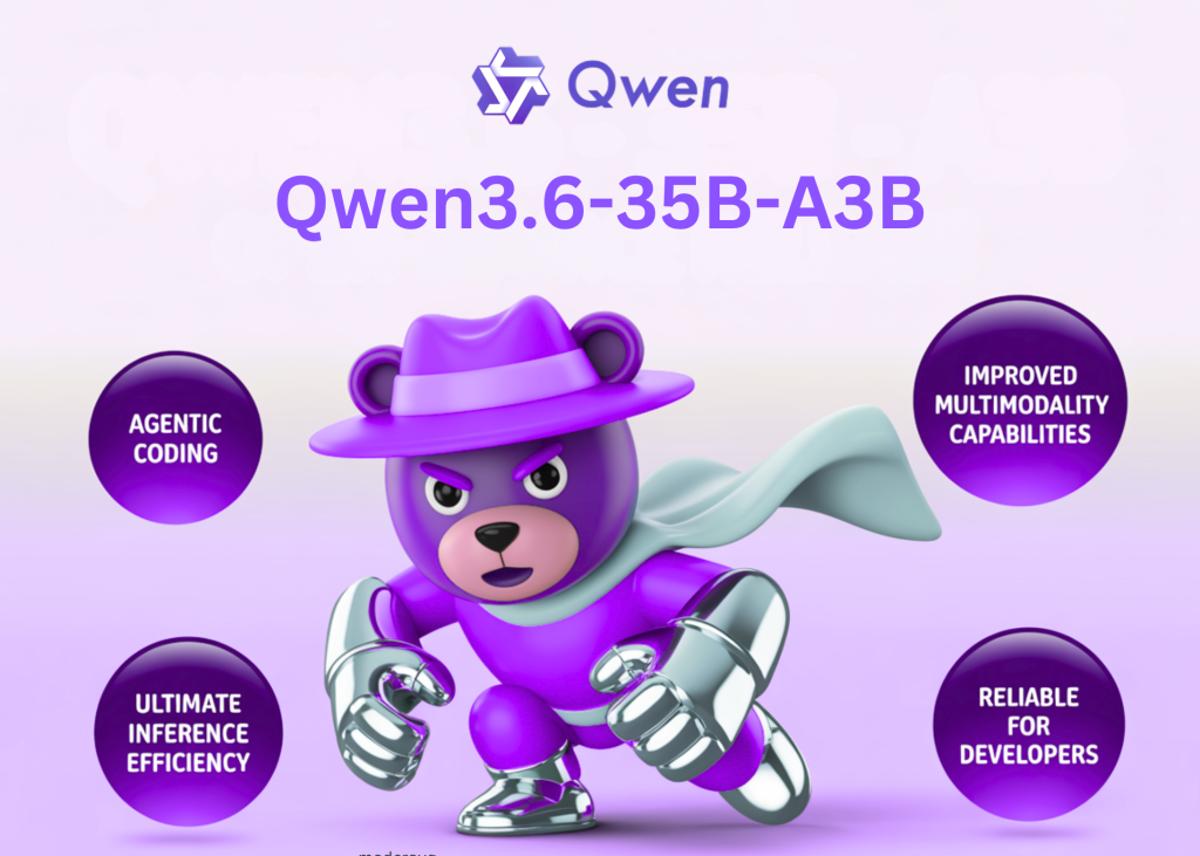
Qwen Team Open-Sources Qwen3.6-35B-A3B: A Sparse MoE Vision-Language Model with 3B Active Parameters and Agentic Coding Capabilities

Companies Mentioned

Why It Matters
By delivering high‑performance coding and multimodal reasoning with a fraction of active parameters, Qwen3.6‑35B‑A3B lowers inference costs and accelerates adoption of open‑source LLMs in enterprise AI pipelines.
Key Takeaways
- •Sparse MoE architecture activates only 3 B parameters, cutting inference cost
- •Achieves top Terminal‑Bench 2.0 score, showing strong agentic coding
- •Outperforms rivals on multimodal benchmarks like MMMU and VideoMMMU
- •Introduces Thinking Preservation, reusing reasoning traces for efficient agents
Pulse Analysis
The rise of Sparse Mixture‑of‑Experts (MoE) models is reshaping the economics of large language models. Qwen3.6‑35B‑A3B exemplifies this shift by packing 35 billion total parameters into a network where just 3 billion are active for each token. This selective routing, combined with linear‑attention Gated DeltaNet layers and Grouped Query Attention, slashes compute demand and KV‑cache pressure, enabling affordable inference even at context windows exceeding one million tokens. For organizations wary of the soaring costs of dense 100‑billion‑parameter models, the Qwen release offers a cost‑effective alternative without compromising capability.
Beyond efficiency, the model’s agentic coding prowess sets a new benchmark for autonomous software development. On SWE‑bench Verified it posts 73.4, edging out its predecessor, while a 51.5 score on Terminal‑Bench 2.0 marks the highest performance among all evaluated models, including larger rivals. These results translate into practical gains: developers can deploy AI‑assisted coding assistants that reliably resolve real‑world GitHub issues and generate front‑end code across diverse categories, from web apps to 3‑D visualizations. The strong coding metrics suggest a near‑term acceleration of AI‑driven development workflows in enterprise settings.
Qwen3.6‑35B‑A3B also pushes multimodal intelligence forward. With native vision encoders, it attains 81.7 on MMMU and 85.3 on RealWorldQA, surpassing leading proprietary models. Its new Thinking Preservation feature lets the model retain reasoning traces across conversation turns, improving consistency for multi‑step agent tasks while reducing redundant computation. Released under Apache 2.0 and compatible with major inference frameworks, the model invites rapid integration into commercial products. As open‑source LLMs gain parity with closed‑source offerings, Qwen3.6‑35B‑A3B positions itself as a versatile, cost‑efficient engine for both coding assistants and multimodal AI applications.
Qwen Team Open-Sources Qwen3.6-35B-A3B: A Sparse MoE Vision-Language Model with 3B Active Parameters and Agentic Coding Capabilities
Comments
Want to join the conversation?
Loading comments...