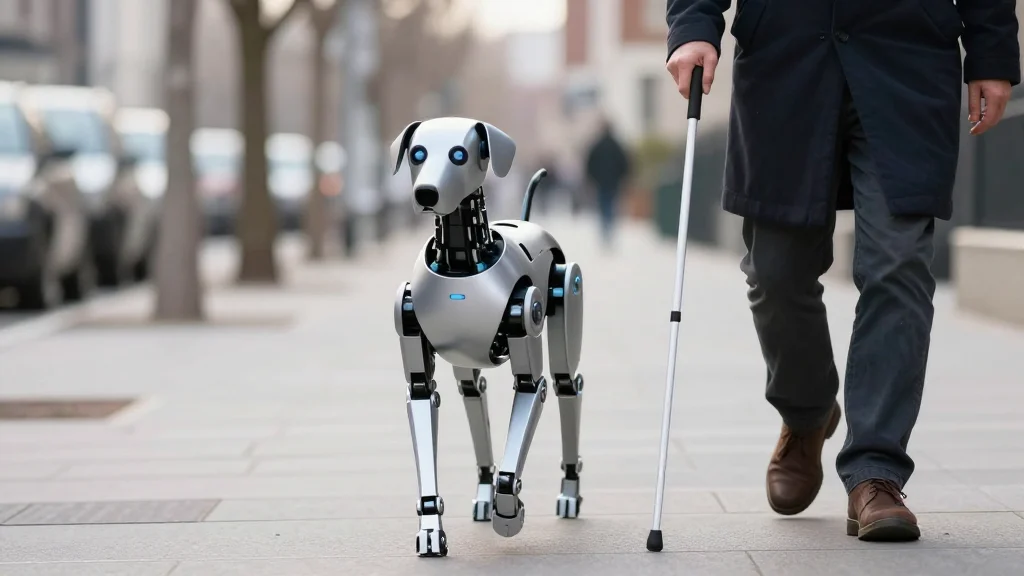
Researchers Build a Talking Robot Guide Dog to Help Visually Impaired People Navigate

Why It Matters
The technology could dramatically broaden mobility assistance for the visually impaired, reducing dependence on scarce, costly trained dogs. It also marks a significant step toward AI‑driven personal robotics in everyday accessibility solutions.
Key Takeaways
- •Prototype combines large language model with navigation planner
- •Enables spoken, interactive route guidance for visually impaired users
- •Addresses low adoption rate of traditional guide dogs (~2% US)
- •Real-time replanning adjusts routes based on user queries
- •Demonstrated at AAAI 2024, paving path for commercial development
Pulse Analysis
Guide dogs have long been the gold standard for independent navigation among visually impaired individuals, yet the breeding and training pipeline is lengthy and expensive, limiting adoption to roughly two percent of the U.S. population. As urban environments become more complex, the need for scalable, affordable assistance solutions grows. Artificial intelligence, particularly large language models, offers a promising avenue to replicate the conversational guidance traditionally provided by a living animal, while sidestepping the logistical bottlenecks of canine training.
The Binghamton team’s robot merges a state‑of‑the‑art language model with a real‑time navigation planner, allowing it to interpret natural‑language queries such as “Where’s the nearest water fountain?” and respond with spoken directions, distance estimates, and alternative routes. Integrated sensors map the immediate environment, feeding spatial data to the planner, while the language model translates that data into user‑friendly narration. This dual‑system architecture enables dynamic replanning; if a user changes their mind mid‑journey, the robot can instantly adjust its path and convey the updated instructions.
If commercialized, such robotic guide dogs could lower the barrier to mobility assistance, offering a cost‑effective, instantly deployable alternative to animal partners. However, challenges remain, including ensuring reliable performance in diverse weather conditions, safeguarding user privacy, and achieving regulatory approval for public use. Continued research and pilot deployments will be crucial to refine the technology, but the prototype signals a broader shift toward AI‑enabled assistive devices that could reshape accessibility standards across the United States and beyond.
Researchers Build a Talking Robot Guide Dog to Help Visually Impaired People Navigate
Comments
Want to join the conversation?
Loading comments...