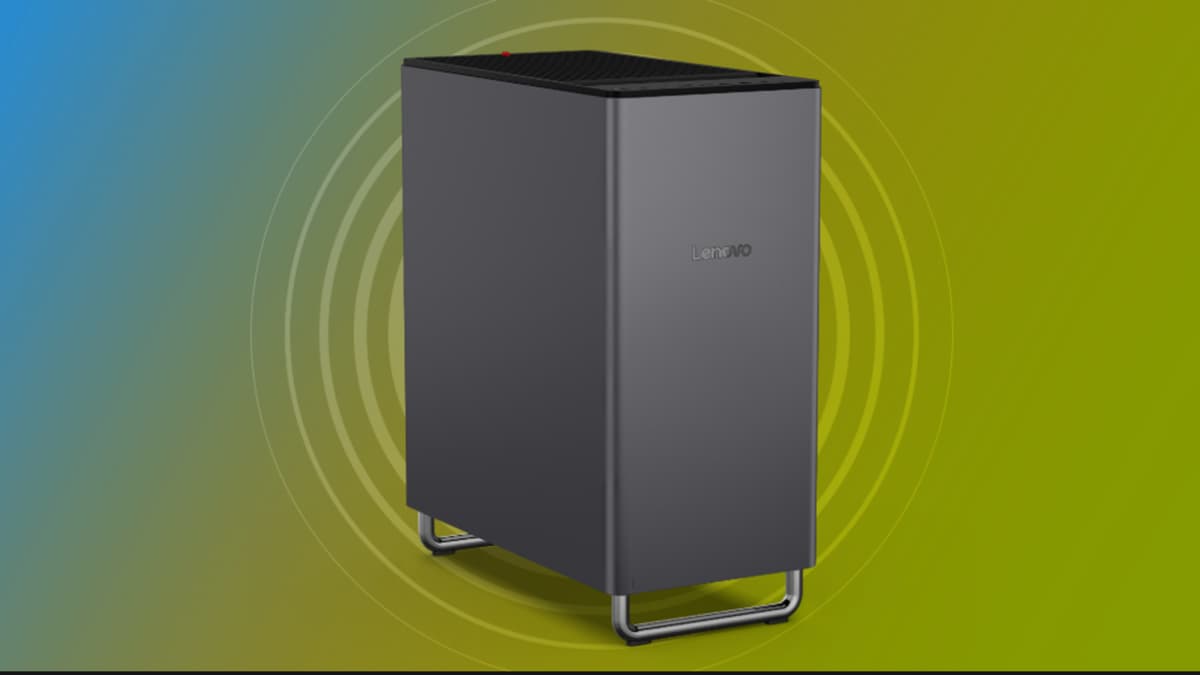
Return of the SLI: Lenovo's New Workstation PC Supports up to Two RTX 5060 Ti GPUs for AI Inference - but I'm More Interested in the Secretive 1TB AI Fusion Card
•January 7, 2026
0
Companies Mentioned


Why It Matters
Re‑introducing multi‑GPU SLI for inference gives enterprises on‑premise performance for massive LLM contexts, while the AI Fusion Card brings local fine‑tuning, cutting cloud latency and security risks.
Key Takeaways
- •Dual RTX 5060 Ti provides 32 GB combined VRAM
- •Supports >100 K token LLM inference with MoE models
- •1 TB AI Fusion Card fine‑tunes up to 70B parameters
- •Intel Core Ultra 9, up to 256 GB DDR5 memory
- •Starts $1,500, available March 2026
Pulse Analysis
The ThinkCentre X Tower marks a notable shift in AI workstation design, reviving SLI‑style multi‑GPU scaling for inference workloads. By pairing two RTX 5060 Ti cards, Lenovo delivers 32 GB of combined VRAM, a sweet spot for running large‑context language models that would otherwise exceed single‑GPU memory limits. This architecture reduces reliance on cloud‑based inference services, offering enterprises tighter control over latency, data sovereignty, and cost predictability. The inclusion of high‑bandwidth DDR5‑6400 memory and ample PCIe lanes further ensures that data can flow efficiently between CPU, GPU, and storage.
Beyond raw GPU power, the 1 TB AI Fusion Card is the system’s most intriguing component. Acting as a dedicated accelerator for post‑training and fine‑tuning, it enables on‑premise adaptation of models up to 70 billion parameters—tasks traditionally reserved for large data‑center clusters. This capability addresses growing concerns around data privacy and regulatory compliance, as sensitive datasets can remain within corporate firewalls while still benefiting from rapid model iteration. The Fusion Card’s integration with Lenovo’s Sensor Hub also hints at a future where AI workloads adapt in real time to environmental inputs, optimizing power and performance dynamically.
From a market perspective, Lenovo’s pricing strategy positions the X Tower as an accessible entry point for midsize firms seeking AI‑ready hardware without the expense of enterprise‑grade servers. At $1,500, it undercuts many competing workstations while still delivering enterprise‑grade features such as ThinkShield security and modular airflow for sustained workloads. As AI adoption accelerates across industries, the combination of dual‑GPU inference and localized fine‑tuning could set a new benchmark for on‑premise AI infrastructure, prompting rivals to explore similar multi‑GPU and accelerator‑centric designs.
Return of the SLI: Lenovo's new workstation PC supports up to two RTX 5060 Ti GPUs for AI inference - but I'm more interested in the secretive 1TB AI Fusion Card
0
Comments
Want to join the conversation?
Loading comments...